
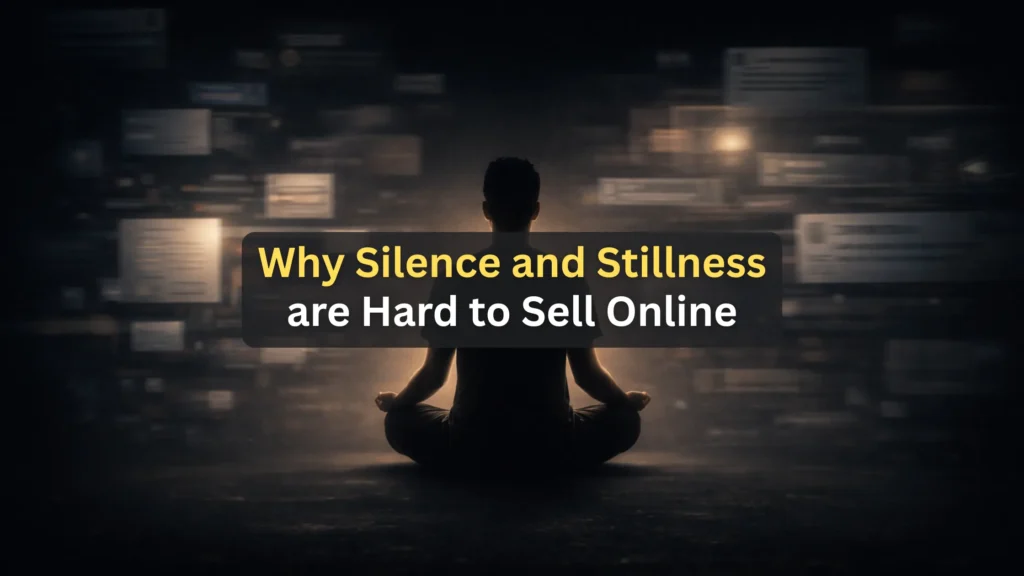
I used to think the internet rewarded noise.
But that’s not quite true.
The internet rewards stimulation.
And silence does not stimulate.
It invites.
That distinction explains almost everything.
The Friction Is Not Algorithms. It’s Thinking.
Most retreat leaders assume the problem is reach.
Low engagement.
Unpredictable visibility.
Content not “performing.”
But when you step back, the real friction is conceptual.
We expect silence to sell the way entertainment sells.
We expect stillness to compete with stimulation.
That expectation is the real misalignment.
In Retreat Marketing When Thinking Comes First, I explain that marketing problems are often thinking problems first.
When the internal model is unclear, tactics amplify the confusion.
Silence struggles online not because it lacks value, but because it contradicts the mental model most people bring to digital spaces.
Silence Is Experiential, Not Conceptual
You cannot explain silence into desire.
You have to feel it.
Online decisions, however, are often made quickly. They are reactive. Emotional. Stimulus-driven.
Silence requires safety before it creates desire.
Without trust, silence feels like emptiness.
With trust, silence feels like relief.
That trust threshold is what most brands underestimate.
This is why clarity precedes conversion.

In Email Marketing for Retreats: Why Trust Compounds When Thinking Is Clear, I explore how consistency of thought builds confidence over time.
Silence-based offers convert through familiarity, not urgency.
You are not persuading people into stillness.
You are helping them recognize it.
Stillness Disrupts the Productivity Narrative
Online culture glorifies output.
Launches.
Scaling.
Optimization.
Momentum.
Stillness interrupts that rhythm.
It suggests pausing instead of pushing.
But pause does not translate well into dashboards.
There is no obvious metric for reflection. So subconsciously, stillness gets labeled as “unproductive.”
This creates internal resistance in buyers.
They may crave quiet, but they struggle to justify it.
The tension isn’t logical.
It’s cultural.
And unless your positioning addresses that tension directly, your marketing will always feel like it’s swimming upstream.
Visual Platforms Struggle With Quiet
Digital platforms are built on motion.
Movement signals importance.
Silence looks static.
A calm image may be beautiful.
A slow video may be grounded.
But beside high-energy content, it can feel invisible.
So creators compensate.
They add hooks. Music. Faster edits.
And in doing so, they dilute the very quality they are trying to sell.
This is where your principles matter.
If silence and stillness are foundational to your work, your communication must embody that energy. Not theatrically. Not performatively.
But coherently.
In Marketing Funnels for Retreats, I mention that funnels don’t create growth, they reveal it.
The same applies here.
Content doesn’t create depth. It reveals whether depth is truly present.
Silence Requires Maturity, From Both Sides
Silence does not compete.
It filters.
It attracts people who are ready.
That means the audience will likely be smaller, but more intentional.

This is where many retreat brands misinterpret performance data.
They assume lower engagement means lower value.
In reality, it may mean higher discernment.
This principle connects closely to what I explore in Clarity Over Keywords: How ChatGPT Understands What You Do.
Visibility in modern systems, whether algorithms or AI, increasingly rewards coherence over noise.
When your thinking is clear, your message stabilizes.
And stable messages attract stable decisions.
The Real Question
The challenge was never:
“How do I sell silence online?”
The better question is:
“Who is ready for silence right now?”
That shift changes the entire strategy.
- You stop optimizing for reach.
- You start optimizing for resonance.
- You stop chasing performance spikes.
- You start building relational depth.
And depth compounds differently.
What happens when something is hard to express
Not everything can be clearly explained. Some experiences can only be felt and recognised slowly.
That becomes clearer across three layers:
Decision Layer
What people are really searching for when they book a Retreat
Articulation Layer
Why Retreats sell emotionally, not logically
Trust Layer
Email Marketing for Retreats: Why Trust Compounds When Thinking Is Clear
When articulation is limited, trust carries the decision forward.
What This Actually Means
Silence cannot be sold through explanation.
It can only be recognised.
If the experience is forced into words, it loses depth.
If it is left completely unexpressed, it remains unseen.
That is why marketing these experiences feels difficult, not because they lack value.
But they require a different kind of clarity.