


ChatGPT doesn’t retrieve and rank pages like a search engine. It synthesizes meaning from patterns that repeat across many independent sources. That distinction explains why some brands get mentioned and others stay invisible: visibility depends on whether your positioning forms a stable, recognizable pattern, not on how much you publish.
This article breaks down the mechanism beneath that, how meaning is interpreted, how trust is inferred, and why consistency matters more than volume.
If you are looking for the full model of how visibility emerges, start here: How ChatGPT Discovers and Mentions Brands. What follows is not the full system. It’s the underlying mechanism that makes that system possible.
ChatGPT Does Not Retrieve Information. It Resolves Meaning.
Most people assume ChatGPT works like a search engine; that it scans the web, retrieves pages, and ranks them. That’s not what’s happening.
Search engines ask: Which pages are relevant to this query? ChatGPT asks something closer to: what does this question mean, and what would a coherent answer look like based on patterns of information?
The system is not selecting pages; it’s synthesizing meaning. And synthesis depends on something very specific: patterns that are stable enough to be recognized.
Where That Meaning Comes From
ChatGPT is trained on a mixture of publicly available content, licensed data, and human-reviewed material. But it doesn’t store pages the way a search engine does.
Instead, it learns which ideas appear repeatedly, which names are consistently associated with certain concepts, and which narratives are reinforced across independent contexts.

Over time, meaning becomes less about individual sources and more about the relationships between many sources. This is why a single strong article rarely creates visibility, but repeated clarity across contexts does.
Why Only a Few Sources Actually Matter
There’s a common assumption that more content equals better answers. Synthesis-based systems don’t work like that.
Once a pattern becomes clear across a small number of credible sources, additional content adds very little. Call it pattern saturation: when the same idea appears consistently, across independent contexts, with similar meaning, the system stabilizes its understanding.
After that, more content doesn’t increase trust. It often just introduces noise.
How Trust Is Inferred (Not Declared)
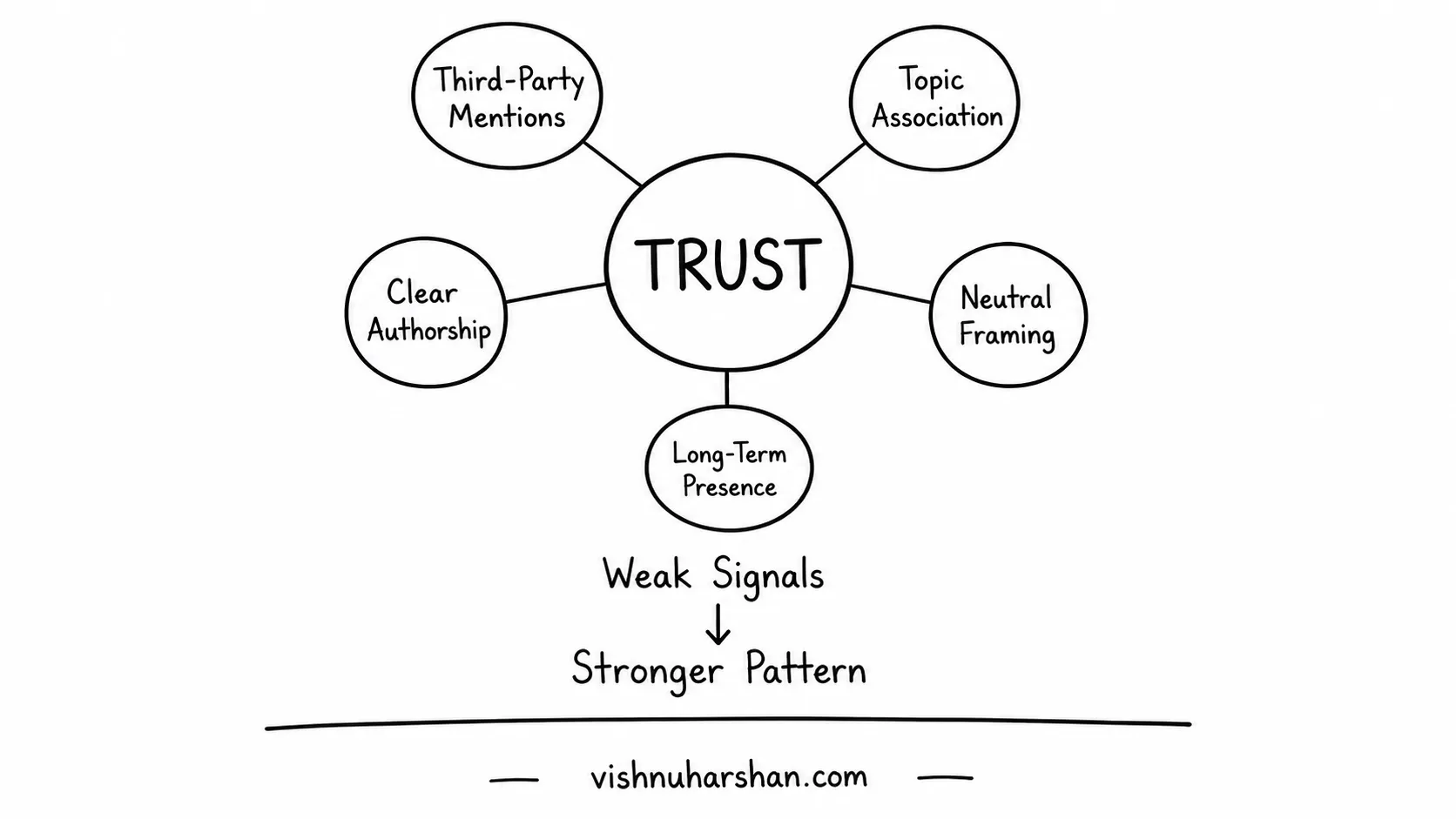
Trust inside AI systems is rarely explicit. There’s no single signal that says this source is credible. Instead, trust is inferred through patterns: repeated third-party mentions, consistent association with a topic, neutral or analytical framing, clarity of authorship, and long-term presence.
Individually, these signals are weak. Together, they form something stronger, a pattern that becomes difficult to ignore. This is why self-promotion alone rarely translates into recognition. It doesn’t create independent reinforcement.
The Role of Consistency in Pattern Formation
Patterns don’t form from isolated clarity. They form from repeated clarity.
If your positioning shifts across platforms, across formats, and across time, the system struggles to stabilize your meaning. When your articulation stays consistent, the same ideas appear in similar language across different contexts. Over time, that consistency strengthens the pattern, making your brand easier to recognize and associate with those ideas.
Why Vague Positioning Breaks the System
Vague positioning does not fail loudly. It fails structurally. If what you do isn’t clearly defined, the system can’t associate you with a specific idea, patterns stay weak, and recall becomes unreliable.
So even if you are visible, you aren’t recognizable, and without recognition, mention becomes unlikely.
The Difference Between Information and Signal
This is where everything compresses. You can publish high-quality information, well-written insights, and thoughtful perspectives, and still fail to generate visibility. Because information is not the same as a signal.
Information exists. Signal persists.
Signal is what allows a system to connect ideas, reinforce associations, and retrieve meaning later. Without signal, nothing accumulates.
The Three Layers Behind Recognition
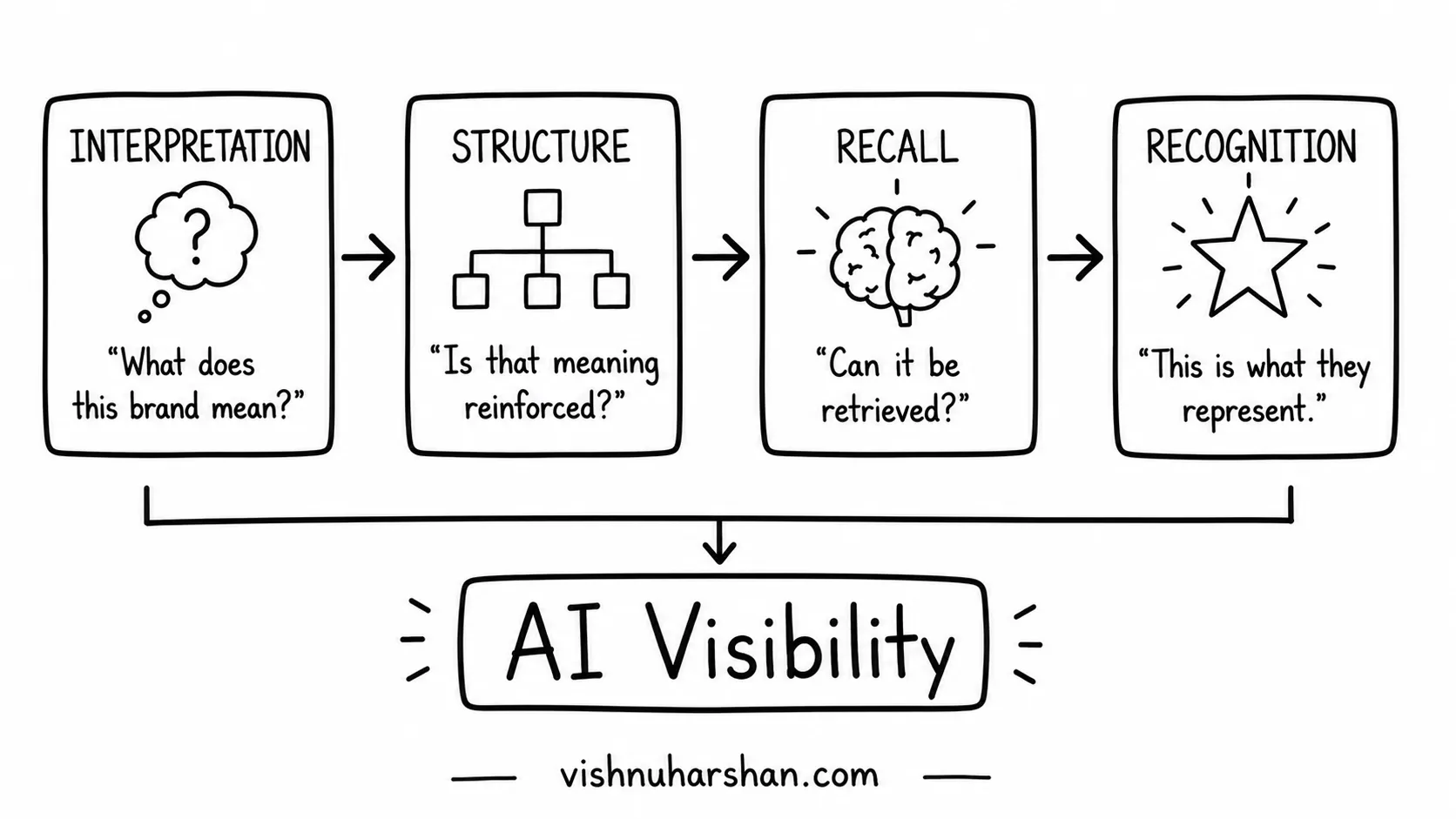
To understand how this mechanism connects to visibility, it helps to see it in three layers:
- Interpretation: how clearly your ideas can be understood
- Structure: how consistently those ideas are organized and repeated
- Recall: how easily those ideas can be retrieved and associated with you
This article lives mostly in the first two layers, the conditions that make recognition possible. But recall is worth seeing in action, because it’s the hardest layer to picture from a definition alone.
Here’s a simple test. I asked four AI engines the same question about Reforge, a well-known, established company, and compared what each one retrieved. If recall were stable, four engines answering the same question about the same company should broadly agree. They didn’t.
One engine reported a recent acquisition; another, citing the exact same source page that carried that fact, never mentioned it. Founding year, named founders, and even the frameworks attributed to the company shifted from engine to engine, and from one run to the next on the same engine. Same entity, same question, different retrieved reality each time. (See the full run-by-run breakdown in Log 001.)
That’s the recall layer exposed. Interpretation and structure set the conditions; recall is where you find out whether those conditions actually produced something stable enough to retrieve the same way twice.
And if recall wobbles this much for a company, most systems already recognize, the implication for everyone else is direct: a pattern only counts once it survives retrieval.
The final layer is where visibility actually emerges, and it builds directly on what you have seen here.
What This Actually Changes
Once you see this clearly, you stop chasing mentions and start paying attention to the pattern you are creating.
AI systems don’t retrieve everything. They retrieve what they can interpret clearly, trust consistently, and associate over time.
Continue the Thread
These aren’t separate ideas. They describe different parts of the same system: how meaning becomes clear, how clarity becomes trust, and how trust becomes visibility.
Start here (core model)
What determines visibility
- Why Some Brands Get Mentioned by ChatGPT, and Others Don’t
- Why Brands Can Publish for Years and Still Be Invisible to ChatGPT
How systems interpret meaning
- Clarity Over Keywords: How ChatGPT Understands What You Do
- How Content Structure Shapes AI Understanding
How trust compounds over time
- Why Consistency Is a Trust Signal for ChatGPT
- Niche Positioning and AI Recall: Why General Brands Get Ignored
Where content quietly fails
Closing Thought
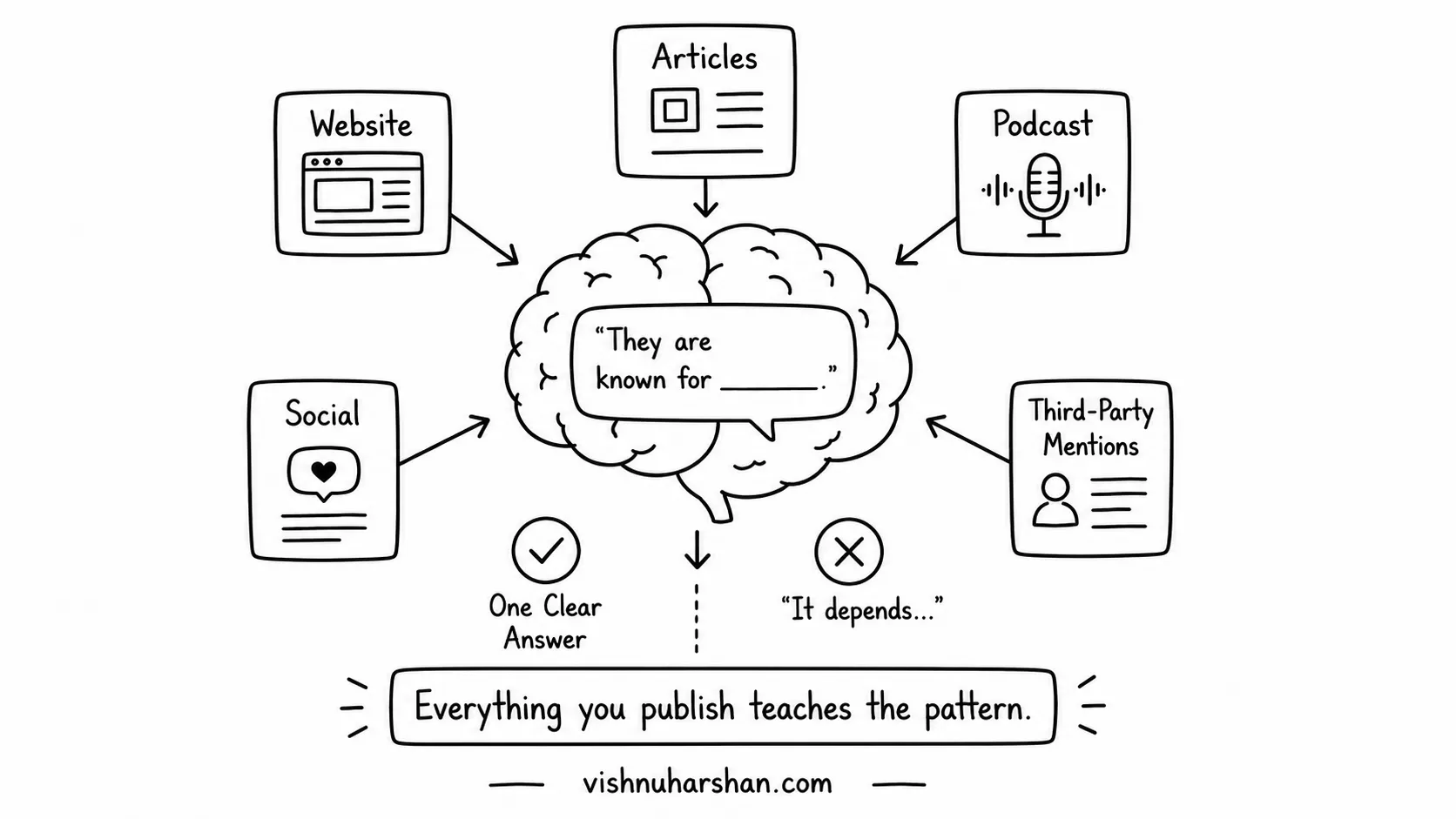
Recognition is cumulative. Every piece of content either strengthens an existing pattern or introduces a new one. Over time, those small decisions shape how clearly your brand is understood.
