

Every founder can tell you the moment their marketing stopped working.
The ad CTR dropped.
The leads dried up.
The campaign flopped.
They point to a date. A metric. A change in the algorithm.
But here is the ahrd truth…
They are almost always wrong.
The Breakdown Happened Earlier
Marketing doesn’t stop working the way a light bulb stops working… sudden, visible, final.
It stops working the way a relationship does.
Quietly. Gradually.
Through a series of decisions that each felt reasonable at the time.
By the time you notice, the problem is months old 🙁
You changed your messaging to sound more professional.
Just a few words. No big deal.
You added a new service because a client asked. Why not?
You ran a different ad format because someone in a Facebook group said it was working for them. Seemed worth testing!
None of these felt like decisions. They felt like adjustments.
But each one moved you slightly off your original clarity. And clarity, once diluted, doesn’t announce its departure…
It just quietly stops producing results.
What This Looks Like in Practice
A consultant I worked with had built something rare… a genuinely specialised practice helping students gain admission to BS/MD programmes.
Highly competitive. High-stakes. And she was good at it.
Her marketing worked because her positioning was precise.
She knew exactly who she was for, and parents who needed that specific outcome found her.
Then she decided to expand!

General college admissions. Broader audience. More revenue potential.
It made sense on paper.
New campaigns launched. New teachers were brought in to handle the increased volume.
The team grew quickly to keep up with what she expected to be growing demand.
But the demand didn’t grow the way she anticipated. Lead costs climbed.
Enquiries became harder to convert.
The team was stretched across two very different services, and neither was getting the focused attention it needed.
Then the complaints started. Not about results. About experience!
Parents, the same parents who had trusted her implicitly for BS/MD admissions, were now questioning the quality of what they were receiving…
The original business started to suffer.
When she came to examine what had gone wrong, everyone pointed to the campaigns.
The ads. The conversion rate. The team.
But the moment things actually broke was months earlier, when she made the expansion decision without first asking whether her positioning could support it.
‘Whether her team could hold quality across two distinct services.”
‘Whether the clarity that had made her BS/MD practice successful would survive being stretched into a broader, more generic offering.’
It couldn’t.
And no amount of campaign optimisation was going to fix that.
Why Founders Misread the Timeline
When revenue slows, attention goes to the most recent thing that changed.
New agency. New platform. New offer. New season.
That’s where the blame lands.
But the real cause is usually buried in something that happened two months ago.
Six months ago. Sometimes longer……..
A positioning statement that was simplified until it lost its edge.
An audience that was broadened until it became everyone, which means no one!
A content strategy that started with a clear point of view and slowly drifted into generic advice because generic advice feels safer.
The recent failure isn’t the cause.
It’s the symptom.
What "It Stopped Working" Usually Means
When founders say their marketing stopped working, they usually mean one of three things:
Their ads aren’t converting. But the real issue is that their messaging no longer reflects what they actually do. Or who they actually do it for.
Their content isn’t bringing leads. But the real issue is that they have been publishing without a clear position. Helpful content, yes. But helpful to whom? And toward what decision?
Their funnel isn’t closing. But the real issue is that trust was never built properly at the top. So by the time someone reaches the bottom, they are not ready.
In each case, the problem isn’t the tactic.
The tactic is just the place where the underlying confusion becomes visible.
The Uncomfortable Truth
Marketing problems almost always begin as thinking problems.
Not thinking in the sense of intelligence…
Thinking in the sense of clarity.
Clarity about who you are talking to. What they are actually trying to solve. Why are you the right answer?
And how to say that in a way that lands!
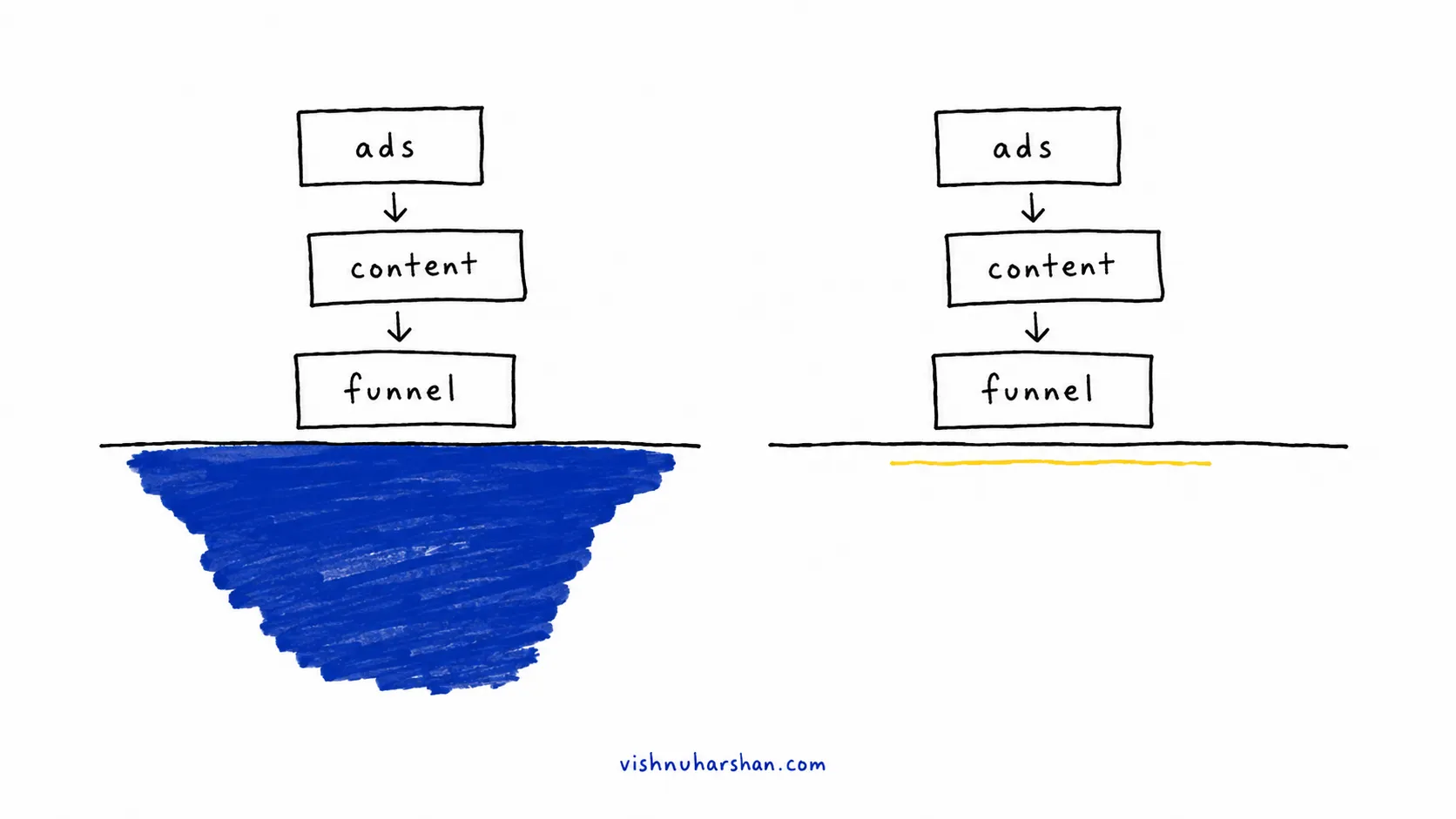
When that thinking is solid, most tactics work reasonably well.
When that thinking is fuzzy, no tactic works well for long.
You optimise your way around the symptom, the results come back briefly, and then fade again.
Because you didn’t fix the source.
The Question Worth Sitting With
Before you change your ad.
Before you hire someone new.
Before you try a different platform.
Ask yourself when, exactly, things started to feel off.
Not when the numbers dropped…
When things started to feel off.
Because your instincts usually caught the drift before the data did. You just didn’t stop to examine it.
What changed around that time?
What decision did you make that felt like a small adjustment but might have been more significant?
That’s usually where the work needs to happen.
What To Do Instead of Reacting
Most founders react to a marketing slowdown by doing more.
More ads. More content. More outreach. More budget… more more more!
Yes, this occasionally works.
More often, it accelerates the burn rate while the core problem remains untouched.
The harder move, and the more useful one… is to slow down and examine the thinking behind your current marketing.
Not the execution. The thinking.
What do you believe about your audience?
Is that belief still accurate?
What do you say about what you do?
Is that still the clearest, truest version of it?
What does your ideal customer need to believe before they say yes?
Are you actually building that belief?
These aren’t creative questions… They are structural ones!
And they are the questions that determine whether any amount of execution will actually work.
If This Resonated, These Are Worth Reading Next
The breakdown described in this article rarely happens in isolation.
It’s usually part of a pattern, one that shows up differently depending on where you look.
The Hidden Cost of Partial Clarity in Marketing – What happens when your thinking is almost clear. Almost is the problem.
Strategy vs Tactics in Marketing Systems – Why fixing the tactic while the strategy is unclear keeps producing the same results.
Your Audience Is a Reflection of Your Thinking – The people you’re attracting tell you more about your clarity than your analytics do.
Why Your Ideal Customers See Your Ads, But Don’t Respond – Reach without response is a thinking problem, not a targeting problem.
