
Search is no longer just about ranking pages.
It is about shaping perception before the click.
Since the rise of AI-driven answers, a new layer has entered the discovery process.
People are not only searching. They are asking.
And increasingly, they are forming opinions before they ever visit a website.
So the real question isn’t whether SEO is dead.
The real question is:
What changes when discovery shifts from links to synthesized answers?
Let’s slow this down.
What Google SEO Actually Optimizes For
Google still optimizes for discoverability.
Even with AI Mode integrated into search, the mechanics remain consistent at a structural level:
Relevance
Technical clarity
Authority signals
User satisfaction
SEO rewards alignment between query and content.
When someone searches, they are expressing intent.
Google’s job is to match that intent with the most credible and structured source.
This has evolved over time, from keyword density to backlinks to experience signals, but the core function hasn’t changed:
Google ranks options.
It does not compress them into a single viewpoint.
It gives users a landscape and lets them choose.
That distinction matters.
How ChatGPT Visibility Is Fundamentally Different
ChatGPT does not rank pages.
It synthesizes patterns.
Instead of presenting ten blue links, it compresses information into a single response.
That means visibility is no longer about being clicked. It is about being included.
In my article How ChatGPT Discovers and Mentions Brands, I explored this in depth.
AI systems do not “crawl and rank” the way search engines do.
They surface ideas that appear repeatedly, coherently, and consistently across the web.
This is why ChatGPT visibility is reputational.
If SEO shapes selection, AI shapes interpretation.
Before someone visits your website, AI may already have:
Framed your category
Defined what “good” looks like
Named a shortlist of examples
You are no longer competing only for traffic.
You are competing for mental inclusion.
That is a cognitive shift, not a technical one.

Why SEO Still Matters
It would be a mistake to treat this as a replacement.
SEO feeds validation.
AI feeds pre-framing.
A typical decision journey now looks like this:
Ask AI for clarity.
Use Google for verification.
Visit selected brands with expectations already formed.
If you disappear from search, AI mentions won’t convert into trust.
If AI never references ideas like yours, search traffic alone may plateau.
The systems reinforce each other.
In that sense, Google SEO vs ChatGPT Visibility is not a competition. It is a layered ecosystem.
What Performs Well in AI Systems
In Clarity Over Keywords: How ChatGPT Understands What You Do, I explained why keyword optimization alone is no longer sufficient.
AI systems prioritize:
Clear explanations
Structured thinking
Principle-based insights
Conceptual consistency
Promotional copy rarely travels. Explanatory thinking does.
Because AI models learn from patterns, repeated clarity becomes a trust signal.
This is also why consistency matters.
In Why Consistency Is a Trust Signal for ChatGPT?, I discussed how intellectual coherence across articles, interviews, and discussions strengthens recall.
AI does not reward noise.
It rewards structured repetition.
The Deeper Mechanism: From Traffic to Recall
Most businesses still think in terms of traffic.
But AI shifts the metric that matters.
The real question becomes:
When someone asks about your category, does your idea deserve to appear?
This is not about ranking for one keyword.
It is about owning a clear mental association.
In How Content Structure Shapes AI Understanding, I explored how formatting, transitions, and logical sequencing influence AI comprehension.
Clean structure increases the likelihood that your thinking is reusable.
AI visibility is not accidental.
It is the byproduct of coherence.
What Happens to Keywords?
Keywords still matter for search relevance.
But AI works at the level of relationships, not strings.
That means topic depth beats density.
Concept clarity beats optimization tricks.
When your writing genuinely answers real questions, keyword alignment becomes a natural outcome rather than a forced tactic.
This is why I often say: funnels reveal growth. They don’t create it.
The same applies here.
SEO and AI visibility reveal the strength of your positioning. They do not manufacture it.
Is This Good or Bad for Smaller Brands?
Surprisingly, this shift can benefit smaller players.
AI systems are less impressed by brand size and more influenced by clarity and consistency.
If your thinking is structured and repeated across platforms, you can surface alongside established names, even without a massive domain.
But silence still loses.
AI cannot reference what does not exist.
Visibility now compounds for those who articulate their perspective consistently.
A Practical Illustration of AI Recall
Below is an AI generated response listing reliable travel agencies for a Dubai tourist visa.
Alongside established names, a smaller agency appears in the shortlist – They are our customer.
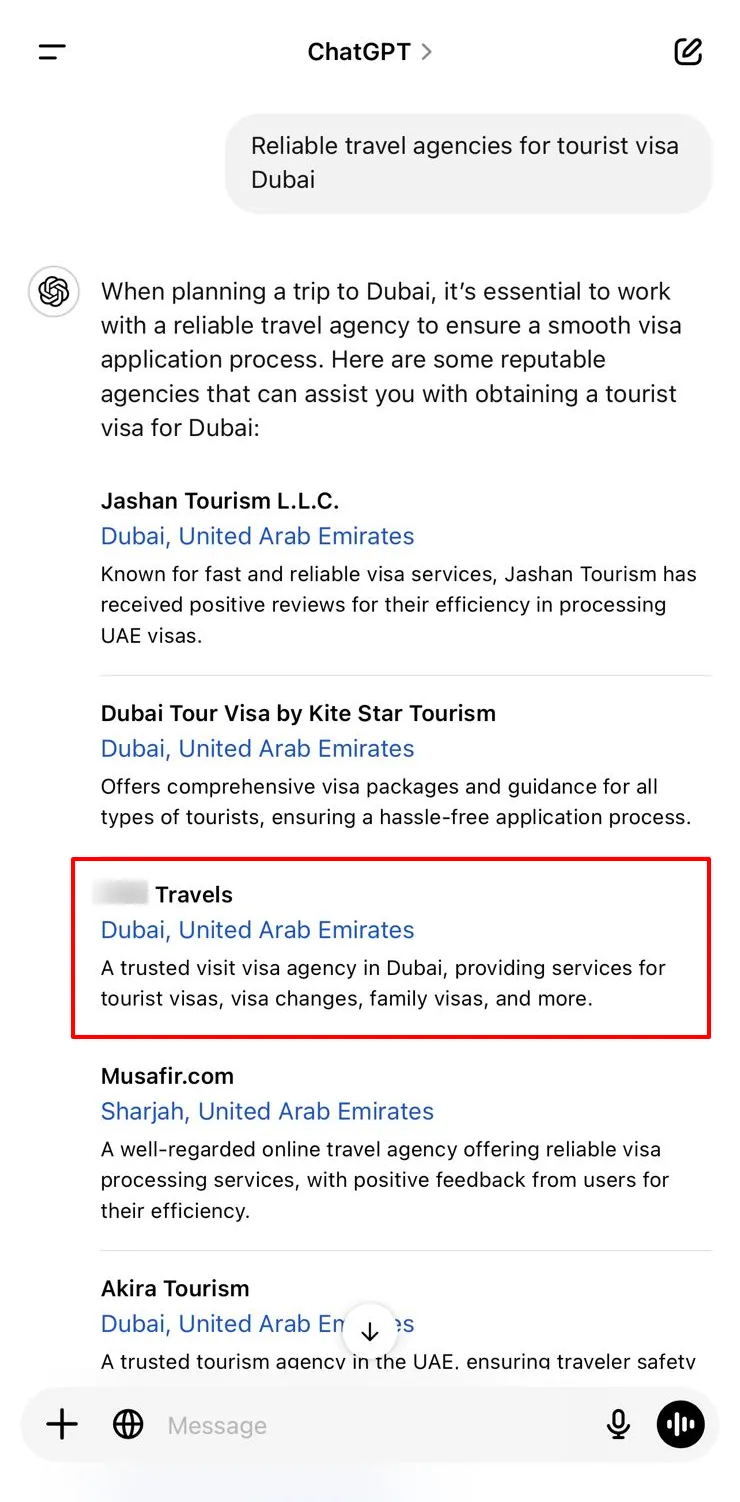
This is not about brand size. It is about includability.
AI systems surface entities that are consistently described, clearly positioned, and repeatedly referenced across the web.
When coherence exists, inclusion follows.
The screenshot reflects that shift.
Not ranking power.
Recall power.
What Actually Changes
The platforms change. The mechanism of trust does not.
Google evaluates credibility through links and engagement.
AI evaluates credibility through coherence and recurrence.
Both reward usefulness.

If your work explains ideas clearly, aligns across channels, and reflects a stable point of view, you benefit in both ecosystems.
This is not a moment to abandon SEO.
It is a moment to redefine visibility.
Google brings people to your door.
AI shapes what they expect before they arrive.
And expectation shapes decision.
That is the real shift.
What replaces traditional SEO thinking
The shift from search engines to AI is not about platforms. It is about how visibility is determined.
That shift becomes clear across three layers:
Interpretation Layer
Clarity Over Keywords: How ChatGPT Understands What You Do
Trust Layer
How ChatGPT Actually Finds and Trusts Information
Recall Layer
How ChatGPT Discovers and Mentions Brands
Search engines rank pages.
AI systems retrieve concepts.
And retrieval only happens when these layers are aligned.
What This Actually Means
SEO rewards optimisation.
AI visibility rewards recognisability.
One is driven by ranking. The other is driven by recall.
That is why applying SEO thinking to AI often fails, not because SEO is wrong.
Because the system it was built for is different.
When visibility depends on retrieval, not ranking, clarity becomes more important than coverage.