


You typed your niche into ChatGPT. Your brand wasn’t there.
ChatGPT can’t place you. Your public footprint doesn’t say clearly enough what you are, so there is nothing stable for the system to attach you to. Publishing more won’t fix that. Neither will a settings change.
This is a coherence problem, and it starts with positioning. That’s what this article covers.
The Three-Layer Model of AI Visibility
AI visibility is not a single event. It is the result of three layers working together:
1. Interpretation Layer
Can the system clearly understand what you represent?
2. Trust Layer
Does that meaning remain consistent across contexts over time?
3. Recall Layer
Can the system retrieve and associate that meaning when needed?
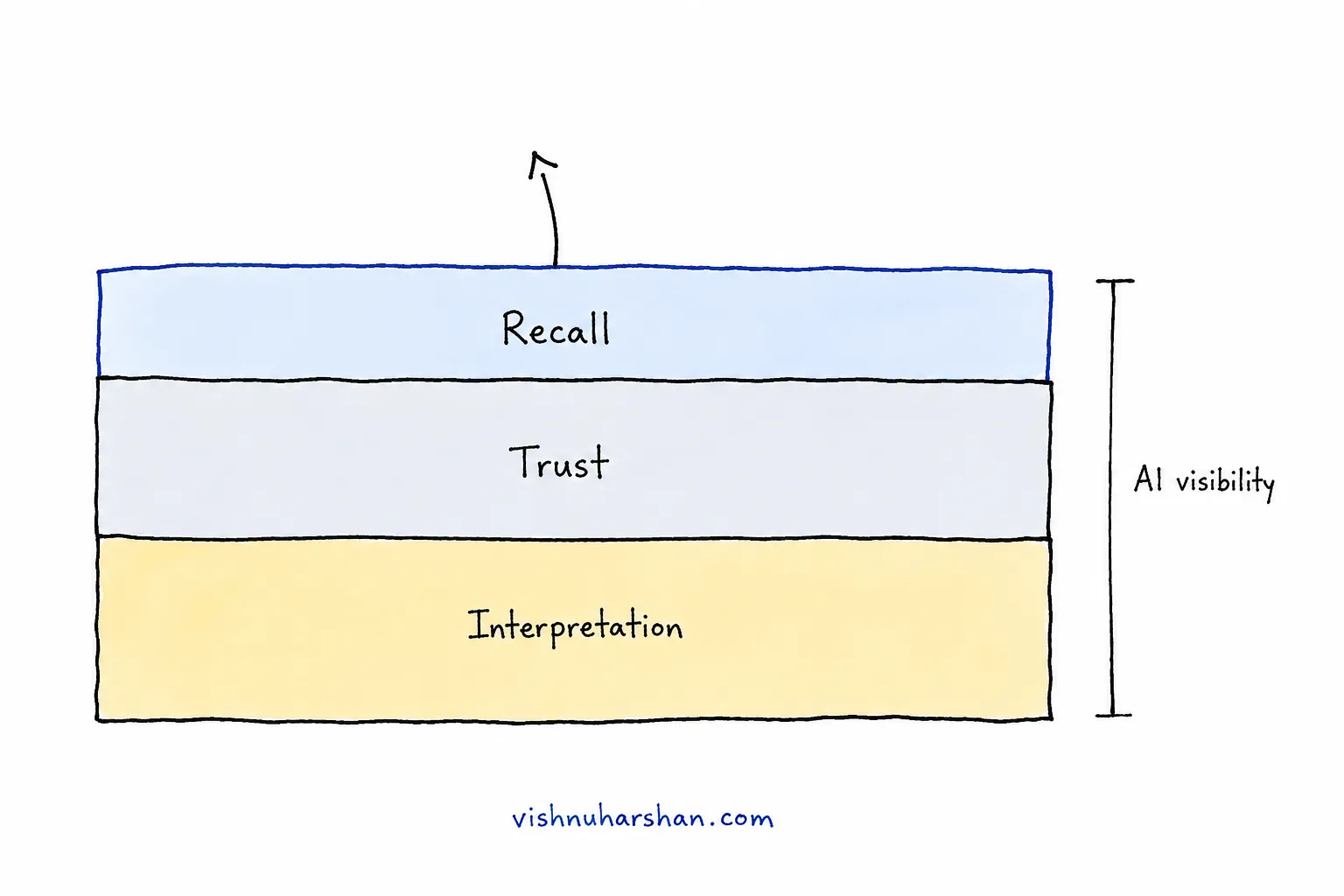
Most brands focus only on visibility. But visibility is the final layer. It depends entirely on what happens before it. This article focuses primarily on the recall layer, where brands are actually mentioned.
But recall is not independent.
It is the visible outcome of what has already been understood and trusted.
The Core Idea Behind AI Brand Visibility
ChatGPT does not discover brands the way search engines find pages. It retrieves patterns. When a brand repeatedly appears in clear, structured contexts around a specific idea, the association strengthens. Over time that association becomes recall.
Brands that communicate with clarity and consistency become easy to place.
Brands that drift between messages become difficult to categorise. And if something cannot be placed, it rarely gets mentioned. This is why AI visibility inside AI systems is not primarily a distribution problem.
It is a coherence problem.
When positioning is stable and articulation is clear, recognition becomes a natural byproduct. Seen this way, recognition is not created by tactics.
It emerges when alignment stabilises your message and articulation makes your thinking easy to understand.
What Most Advice Gets Wrong
If you have read other articles on this topic, you have likely been told some version of this: “Publish more content. Build backlinks. Get listed on directories. Post on Reddit. Add schema markup.”
That advice isn’t wrong…
But it’s incomplete in a way that matters. Here’s the problem: all of that activity assumes your positioning is already clear. It assumes ChatGPT has something coherent to retrieve, and you just need to amplify it further.
But if your positioning is unclear, more content doesn’t fix it. It compounds it :/
You end up with more pages saying slightly different things, more mentions that don’t quite agree on what you do, more noise layered on top of an already fragmented signal. The founder who posts daily and still doesn’t appear in ChatGPT isn’t failing at distribution.
He’s failing at coherence. And no amount of backlinks fixes that.
How ChatGPT Finds and Trusts Information
There is another misconception. People assume ChatGPT “finds” brands the way Google does, by crawling and indexing pages, then serving whoever ranks. Even when it browses the web live, that’s not how it decides which brand to recall. Recognition emerges from:
- Public clarity
- Repetition across credible contexts
- Concept stability
- Language patterns rooted in lived experience
Brands that exist clearly across multiple touchpoints become easier to retrieve. Brands that exist only in isolated fragments remain invisible.
Google SEO vs ChatGPT Visibility: What Actually Changes?
Many founders assume: If I rank on Google, I will be mentioned by ChatGPT. That assumption creates confusion. Google asks: Which page best answers this query right now?
ChatGPT asks:
Which brand or concept do I associate with this idea?

SEO rewards optimisation. ChatGPT visibility rewards recognisability. Google focuses on pages. ChatGPT works at the level of concepts, relationships, and recall.
This difference changes everything.
The Question Most Businesses Ask Wrong
If you have been reading about AI visibility, you have probably asked yourself: “How do I get AI to recommend my brand?” I think that is the wrong question. A better question is:
“Why should AI recommend my brand over every alternative?”
That changes the way you think about AI visibility. Instead of asking how to optimise for AI, you start asking:
- What makes my business genuinely different?
- Why do customers choose us instead of someone else?
- If AI had to justify recommending us, what evidence would it find?
SEO, GEO, structured data, authority, and AI citations all help AI understand your business. They do not create a reason to recommend it.
That reason comes from your positioning.
Clarity Over Keywords: How ChatGPT Understands What You Do
Keywords help search engines. Clarity helps memory. ChatGPT does not think in keyword lists. It understands relationships between ideas.
If someone asks: Who helps retreat facilitators design ethical marketing systems. The system does not scan for keyword density. It recalls which brands consistently show up around:
- Retreat marketing
- Ethical positioning
- Alignment
- Systems thinking
If you have vague positioning, recall collapses. If your positioning is precise, the association strengthens. This is why clarity beats coverage. If you say: “I help businesses grow”
You could mean anything.
If you say: I help retreat leaders design aligned marketing systems rooted in trust. That sticks!
How Content Structure Shapes AI Understanding
Structure is often underestimated. But structure reduces ambiguity.
- Clear headings, Focused sections, Explicit explanations.
Scattered content meaning gets fragmented. But when content is structured, association compounds! Structure does three things:
- Reinforces positioning without sounding repetitive
- Builds stable associations around your niche
- Makes your thinking legible
Over time, legibility becomes recall.
Why Consistency Is a Trust Signal for ChatGPT
Consistency is not about posting daily. It is about identity stability. If one page calls you a founder, another calls you an entrepreneur, another calls you a philanthropist, Association weakens.

AI systems struggle to categorise brands that drift. But when your message remains stable across articles, interviews, frameworks, and case studies, trust builds.
Trust strengthens recall.
Niche Positioning and AI Recall: Why General Brands Get Ignored
General brands try to appeal to everyone. Niche brands speak clearly to someone. ChatGPT, like human memory, retrieves specifics faster than generalities. A brand known for ‘Alignment-first marketing for founders’ is easier to retrieve than ‘Digital marketing services for all businesses.’
Niche positioning answers one powerful question: When should this brand be mentioned? If that trigger is vague, recall fails. If that trigger is precise, recall happens naturally.
Why Some Brands Get Mentioned by ChatGPT and Others Don’t
ChatGPT can browse the web in real time when a question calls for it. But that’s not where brand recall comes from. When someone asks a general question: “Who helps retreat leaders with marketing?”
ChatGPT isn’t scanning your latest post or rewarding whoever published yesterday. It’s drawing on patterns formed during training: which brands consistently appear around which ideas.
Live browsing fetches pages. Recall retrieves associations. The second is what gets you mentioned, and it’s built long before any single query. When a brand consistently appears in clear, structured, credible contexts around a specific idea, that association strengthens.
When positioning is scattered or constantly shifting, recall weakens. Some brands are easy to place. Others are impossible to categorise.
And if something cannot be placed, it cannot be retrieved.
Most of What We Publish Sounds Good. That’s the Problem.
Here is the uncomfortable truth. Most content is polished. Very little content is distinctive. Polished content repeats what is already known.
Distinctive content reflects lived experience.
ChatGPT learns from patterns in language. Content rooted in lived experience contains nuance, specificity, and depth that generic content cannot replicate. That difference matters. Because “good” is not enough.
Recognisable is…
Why Brands Can Publish for Years and Still Be Invisible to ChatGPT
Publishing volume does not equal recognisability. You can publish for years and still remain invisible if:
- Your positioning shifts constantly
- Your content lacks structural clarity
- Your niche is undefined
- Your identity is diluted

Recognition builds slowly through coherence.
Not frequency.
Alignment and Articulation: The Foundation of AI Recognition
This is where most conversations miss the deeper layer. Visibility in AI systems is not a distribution problem. It is an alignment problem. Alignment ensures your message does not drift. Articulation ensures your thinking is legible. Alignment + Articulation = Growth
When alignment is strong and articulation is clear, your: Content compounds, Positioning stabilises, Identity becomes retrievable.
Because recognition is not triggered by tools. It is triggered by coherent thinking. AI systems retrieve what is stable. Stability cannot be faked.
How Long Does It Take?
There is no fixed timeline. Recognition is gradual. It emerges when your:
- Positioning remains consistent
- Content reinforces the same core idea
- Lived experience deepens your articulation
Instead of asking: How fast can I get mentioned? A better question is: Is my message clear enough to be remembered? If the answer is yes, visibility becomes a byproduct.
This Is Not a Set of Tactics. It Is a System.
Everything described so far, clarity, structure, consistency, and positioning, is often treated as separate advice. They are not separate. They are expressions of the same underlying system. AI does not decide what to mention based on isolated signals. It resolves whether something can be:
- clearly understood – consistently trusted – reliably retrieved
These are not independent steps. They are interdependent conditions. If one breaks, the system fails. This is why: More content does not fix weak positioning. Better writing does not fix an unclear structure. Increased activity does not fix the lack of recognition. Because visibility is not created by effort.
It emerges when the system holds.
The Question Worth Sitting With
Most founders leave this conversation looking for the next thing to do. Another platform. Another content format. Another optimization. But the question that actually moves things isn’t tactical. It’s this:
Is my positioning clear enough to be remembered?
Not clear to you, you already know what you do. Clear to someone who encounters your brand once, briefly, in a crowded context. Clear enough that an AI system, trained on millions of patterns, places you in a specific category without confusion.
If the answer is uncertain, that’s where the work starts. Not in publishing frequency, link building, or schema markup, but in the thinking that sits underneath all of it.
The System Behind AI Visibility
Everything discussed in this article fits into a single system. AI visibility is not a single mechanism. It is the result of distinct layers working together. Each layer determines whether a brand is understood, trusted, and ultimately recalled.
1. Interpretation (How meaning becomes clear)
Before anything can be remembered, it must be understood.
- Clarity Over Keywords: How ChatGPT Understands What You Do
- How Content Structure Shapes AI Understanding
2. Trust (How meaning stabilises over time)
Understanding alone is not enough. Meaning must remain consistent across contexts.
3. Recall (How brands get mentioned)
When meaning is clear and stable, it becomes retrievable.
- Niche Positioning and AI Recall: Why General Brands Get Ignored
- Why Some Brands Get Mentioned by ChatGPT and Others Don’t
4. Failure Points (Where visibility breaks)
Most brands don’t fail at effort. They fail at coherence.
- Most of What We Publish Sounds Good. That’s the Problem
- Why Good Content Still Fails to Get Referenced by ChatGPT
- Why Brands Can Publish for Years and Still Be Invisible to ChatGPT
Each of these is not a separate topic. They describe different stages of the same system: How meaning becomes clear, how clarity becomes trust, and how trust becomes visibility.
What This Actually Means
AI visibility is not an optimization problem. It is an interpretation problem. If AI cannot clearly understand what you are, it cannot trust you. And if it cannot trust you, it will not recall you when it matters.
This is why tactics feel inconsistent. They are being applied on top of unclear structure. AI doesn’t surface the most active brands.
It surfaces the most coherent ones. And coherence is created in thinking,
not in execution.
