


Strategies or Tactics are rarely what’s broken. The thinking underneath was never settled, or never got said the same way twice.
Alignment + Articulation = Growth.
Alignment is deciding what’s actually true about your market and who it’s for. Articulation is saying that consistently everywhere you communicate. When both hold, the parts of your marketing start reinforcing each other instead of pulling in different directions.
Everything else on this site is a version of that idea. Marketing feels active. But it doesn’t feel like it’s building momentum.
Ads run, content is published, and funnels are optimized. Still, growth feels slower, harder, or more unstable than expected. Sounds familiar?
Why Marketing Breaks Even When Effort Is High
Marketing struggles don’t begin with poor execution. They begin with fragmented thinking. Businesses often encounter advice from many different sources:
- advertising specialists
- funnel builders
- SEO consultants
- content strategists
- social media experts
Each perspective may be useful. But each perspective usually carries a different underlying model of how growth happens. Without realizing it, businesses begin combining these models together.

Over time this leads to subtle but powerful fragmentation.
- Messaging shifts across channels.
- Offers evolve without a clear reason.
- Content topics drift over time.
- Marketing systems stop reinforcing each other.
None of these decisions feel wrong individually, but together they introduce friction. This is the pattern Tactic Culture accelerates: borrowed advice from multiple sources, each reasonable on its own, combining into a system that fragments rather than compounds.
Growth rarely collapses suddenly. Instead, it slowly loses its ability to compound.
Alignment
Alignment is the foundation! It answers the strategic questions that many businesses never fully articulate:
- Who is this truly for?
- What transformation matters most to them?
- What belief about the market guides our decisions?

Without alignment, marketing activity multiplies while clarity declines. Different channels begin telling slightly different stories. Different campaigns emphasize different ideas. Over time, the business begins chasing tactics rather than reinforcing a clear perspective.
When alignment exists, something changes. Decisions become easier. Messaging stabilizes. Offers feel coherent. Marketing systems begin pointing in the same direction.
Alignment is closely connected to first-principles thinking in marketing. Instead of reacting to tactics, decisions begin flowing from a stable understanding of the market.
Alignment does not create more ideas. It creates fewer ideas that remain consistently true.
Articulation
Alignment alone remains invisible. For growth to happen, clarity must become visible and repeatable. This is articulation! Articulation is often misunderstood as copywriting or messaging, but its role is deeper.
Articulation is the consistent expression of thinking across every place a business communicates:
- websites
- landing pages
- advertising
- content
- conversations with customers
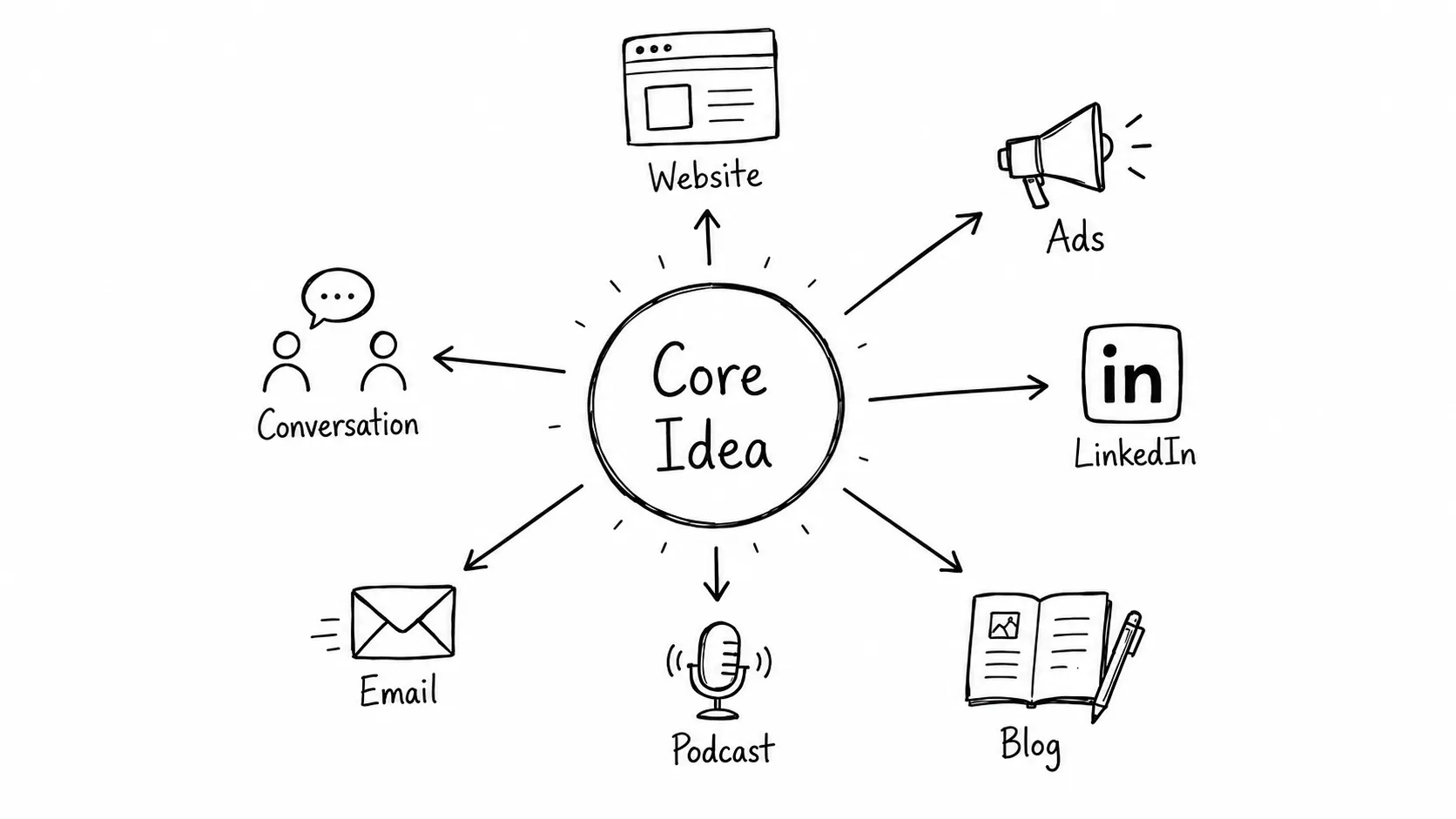
When articulation is strong, the same core idea appears repeatedly in different forms. Over time, this repetition builds recognition. People begin to understand what the brand stands for.
Trust forms more naturally. Buyers feel more confident making decisions.
However, small changes in messaging may appear harmless. But without clear articulation, they slowly weaken the underlying story.
Articulation keeps thinking visible and stable.
Growth
When alignment and articulation work together, marketing begins to behave differently. Instead of isolated activities, channels begin reinforcing each other.
- Content strengthens positioning.
- Positioning strengthens messaging.
- Messaging strengthens conversion.
Each piece amplifies the others, and growth starts to compound. You won’t be able to point at the tactic that did it. Channels amplify the clarity already in the system rather than creating it, which is why adding one rarely fixes what’s actually wrong.
Why This Matters Even More in the AI Discovery Era
The shift toward AI-assisted discovery has quietly made this principle even more important. Large language models increasingly synthesize information across many sources when answering questions.
They do not simply rely on keywords. They look for clear and consistent explanations. In practice, this means recognition forms when:
- ideas are clearly articulated
- perspectives remain stable
- concepts appear repeatedly across content
These patterns help AI systems associate ideas with specific sources, which in turn increases AI Visibility.

In other words, the same clarity that builds human trust also strengthens AI recognition. Alignment ensures the thinking is stable. Articulation ensures the thinking is visible.
Together, they create the conditions for growth to compound in both human and AI-driven discovery environments.
How This Principle Shapes the Topics on This Site
The idea that alignment and articulation create growth sits at the center of everything I write about. Different sections of this site explore different layers of that principle.
Alignment & Articulation
Some articles explore the thinking behind marketing decisions. These pieces focus on clarity, positioning, and the strategic principles that guide how businesses communicate and grow.
Examples include:
- First Principles Marketing: Why Borrowed Strategies Stop Working
- Second-Order Consequences: How Small Marketing Decisions Create Long-Term Drift
- Entropy in Marketing: Why Growth Breaks Without a Single Bad Decision
These articles examine why marketing often breaks long before tactics are executed.
AI Visibility
Other set of articles explores how alignment and articulation influence AI-driven discovery. As more people use AI systems to ask questions and explore ideas, businesses are increasingly recognized through clear explanations repeated consistently across content.
Examples include:
Marketing in Practice
Other articles explore how clear thinking turns into practical marketing systems. These pieces focus on how alignment becomes visible in execution.
Examples include:
Retreat Marketing
Some articles also explore how these same principles apply specifically to retreat-based businesses. Retreats present unique marketing challenges because they sell transformation and emotional outcomes rather than simple products.
Examples include:
- Retreat Marketing When Thinking Comes First
- Why Retreats Sell Emotionally, Not Logically
- What People Are Really Searching for When They Book a Retreat?
These articles examine how alignment and articulation help retreat leaders communicate experiences that are often difficult to describe.
A Simple Equation Behind a Complex System
Marketing appears complex because it involves many platforms, channels, and tools. But beneath that complexity lies a simpler structure. Growth starts when the thinking is clear enough to say out loud and consistent enough to keep saying.

Alignment keeps thinking consistent. Articulation makes that thinking visible. Together, they allow marketing systems to reinforce each other.
Which is why the principle remains simple.
Alignment + Articulation = Growth
