


“Most marketing diagnoses are done by the person who created the problem.”
That’s not an accusation… It’s a structural disadvantage.
When you examine your own marketing, you bring every assumption you have ever made about your business into the examination.
Your read of the data is shaped by what you believe the data should show.
Your diagnosis of what’s wrong is filtered through what you already think the problem is….
The investigation and the investigator share the same blind spots.
This is why smart founders stay stuck!
Not because they aren’t capable of solving the problem.
Because the position they are examining from is the same position that produced it.
What Outside Perspective Actually Does
Outside perspective isn’t superior intelligence.
It’s a different position.
Someone who hasn’t built your assumptions doesn’t share them.
That’s what makes it useful.
Not expertise in isolation.
Expertise applied from a position that isn’t inside the problem.
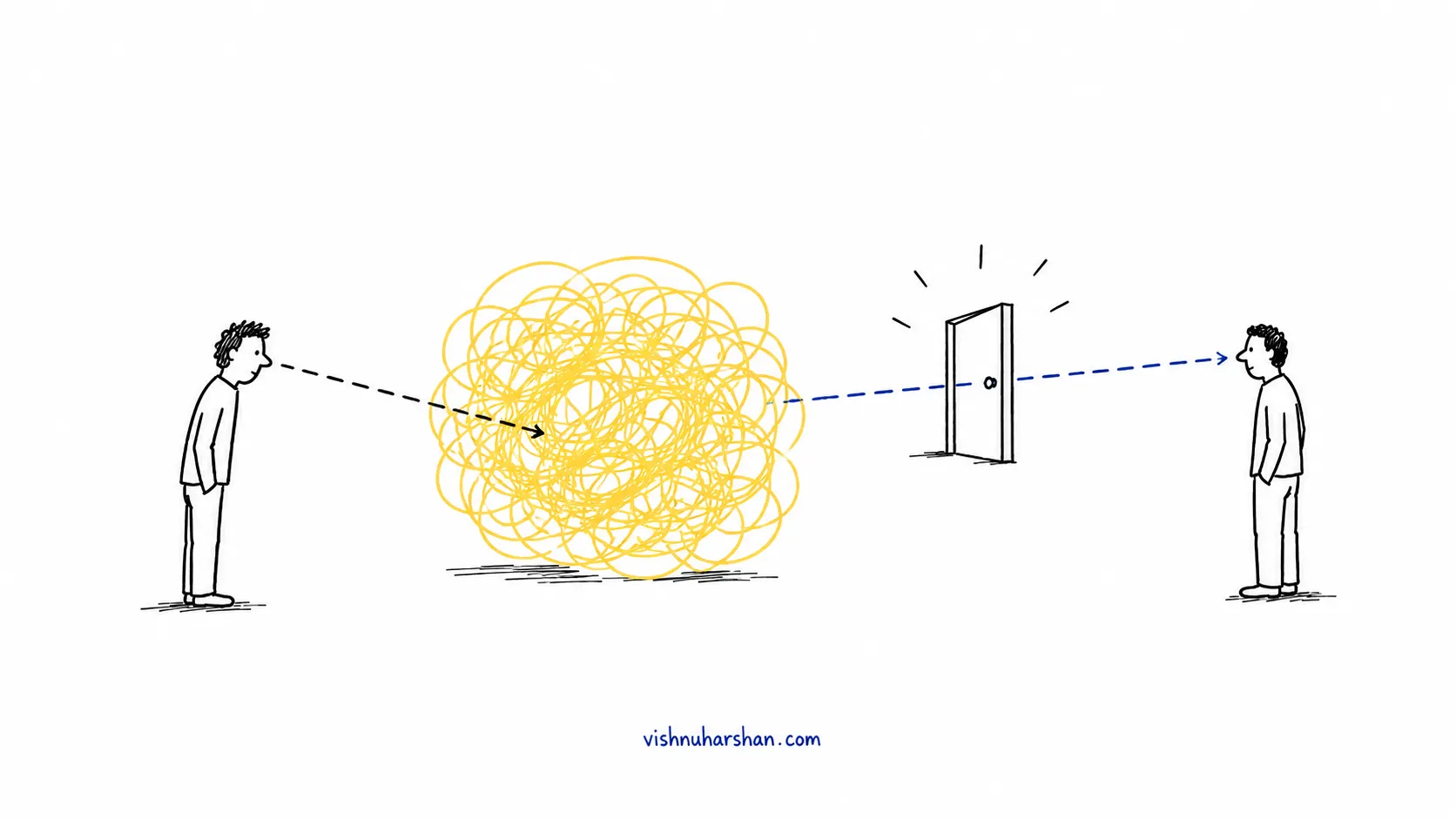
This is also why the most common founder response to an outside diagnosis is surprise.
Not “I should have known that,” but “I never saw it that way.”
The insight wasn’t hidden behind complexity. It was hidden behind proximity.
What That Looks Like in Practice
A fitness founder from India approached me wanting to grow his business.
He had a lead problem, or so he thought.
On the surface, the situation was puzzling…
He had gone through a significant personal transformation, building his own six-pack and documenting it publicly.
His clients were getting real results. He had strong video testimonials.
He had a decent Instagram following. His credibility was visible and earned.
And yet, consistent leads weren’t coming!
His diagnosis was the ads.
He had hired someone to run them, and that person had restricted his Meta business portfolio in the process. Fix the ads, fix the leads.
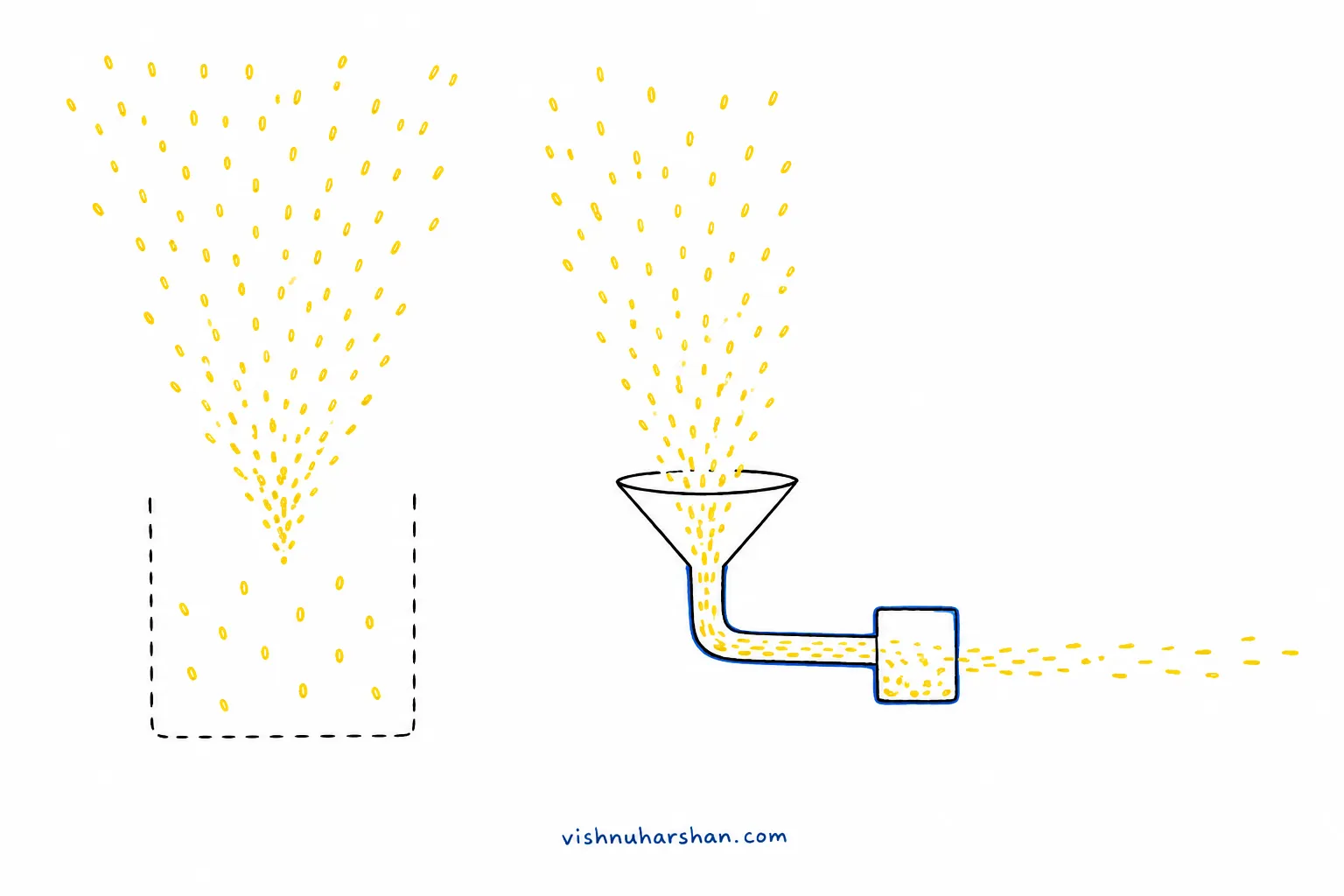
From outside, the picture was different.
There was no marketing funnel to capture and nurture the interest the ads might generate.
No follow-up automation. Not even a consistent manual follow-up process. No data on conversion rates.
Sales calls were handled like casual conversations, with no structure, no script, and no understanding of where prospects were in their decision-making.
The business was generating interest. It had no infrastructure to turn that interest into revenue.
That’s not an ads problem. That’s a systems problem!
And it was completely invisible to him, not because he was inattentive, but because you can’t see what you never knew was missing.
We built the entire system. Funnel, automation, follow-up sequences, sales call scripts, conversion tracking.
His returns increased fivefold.
The ads hadn’t changed. The offer hadn’t changed. The testimonials hadn’t changed.
What changed was that interest now had somewhere to go!
Why the Transformation Made It Harder
There’s something specific to the fitness niche worth naming here, though the principle applies more broadly.
Going through a body transformation, the kind that produces the compelling personal proof this founder had built, requires sustained physical stress, caloric restriction, and fatigue over an extended period.
That process affects cognitive clarity.
It impairs decision-making. Not permanently, and not because the person is weak.
But the physiological demands of transformation are real, and they have cognitive consequences.
This founder was building his most compelling proof at exactly the same time his capacity for clear strategic thinking was most compromised.
He emerged from the transformation with a powerful personal brand and a business full of structural gaps, because the two things happened simultaneously, and one made the other harder to see…
The work of building something can blind you to what the business needs.
In his case, that dynamic was physiological as much as psychological.
He wasn’t just too close to it. He was, for a period, cognitively less equipped to see it clearly.
This is an extreme version of something most founders experience in less dramatic form.
The intensity of building, the focus required, the decisions made under pressure, all of it narrows the lens.
What’s structural, what’s systemic, what’s absent rather than broken, stays invisible precisely because it doesn’t feel like a variable.
It feels like the ground you are standing on.
What Outside Perspective Revealed in Three Other Situations
The fitness founder’s situation wasn’t unique. The same dynamic shows up differently across very different businesses.
A retreat leader in Melbourne set a price and a capacity target based on what others in her space were charging and filling.
From inside, those numbers felt achievable because she had seen them work elsewhere.
From outside, the gap was clear: she was borrowing someone else’s brand authority without the accumulated proof that made those numbers viable for them.
The price wasn’t wrong. The foundation wasn’t there yet!

An education consultant specialising in BS/MD admissions expanded into general college consulting because it looked like a natural growth opportunity.
From inside, the logic was sound: more services, more revenue.
From outside, the structural consequence was visible before it arrived: the specialisation that made her valuable would be diluted, and the marketing that had worked for a precise audience would stop working for a vague one.
A spa owner, less than a year into her business and already running at a loss, couldn’t hold to any marketing strategy for more than a week.
From inside, the strategies seemed to fail.
From outside, the real situation was clear: the business wasn’t stable enough for marketing to work yet.
No strategy was going to survive the panic that instability produced.
In each case, the outside view didn’t require more information than the founder had.
It required a different position from which to read it.
The Structural Limit of Self-Examination
This isn’t an argument a gainst thinking carefully about your own business.
That thinking matters, and it’s where everything starts.
But self-examination has a structural limit.
The assumptions you examine most readily are the ones that feel like assumptions.
The ones that feel like facts, like ground, like the way things obviously are, don’t get examined. They get used!
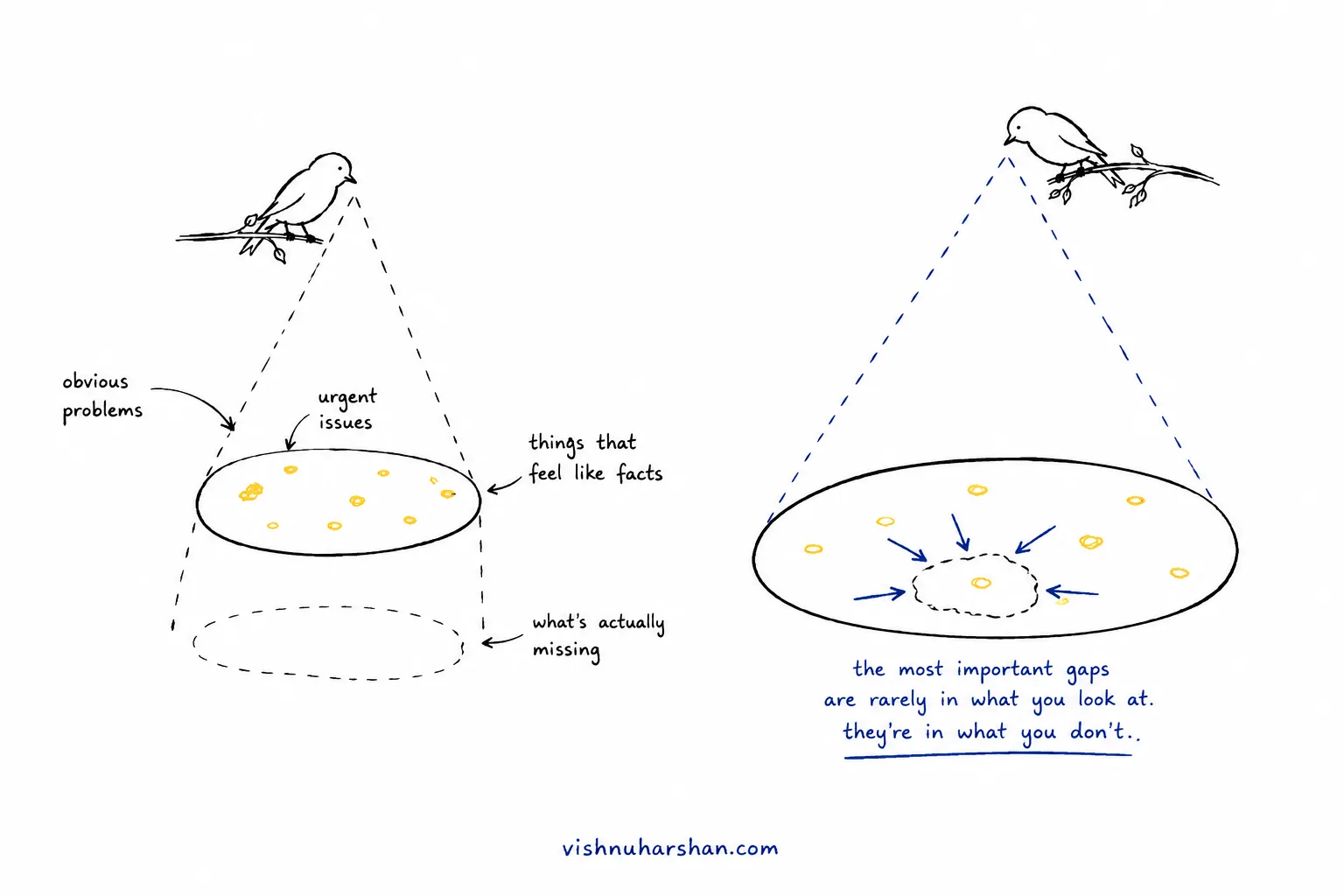
And the most consequential gaps in any business are usually in the things that feel like ground.
The system that was never built because it wasn’t obvious it was missing.
The proof gap that wasn’t visible because the founder couldn’t yet see what a buyer needed to believe.
The positioning drifted because each small change felt like a reasonable adjustment, not a departure.
These don’t surface through harder self-examination.
They surface when someone who doesn’t share your ground looks at what you’re standing on.
If This Resonated, These Are Worth Reading Next
On the thinking layer
The Moment Marketing Stops Working Is Never the Moment You Think It Is: Why the breakdown traces back further than the metric that revealed it.
Tactic Culture: Why Your Marketing Never Compounds: The environment that keeps founders looking in the wrong direction.
On the structural layer
Before You Spend on Marketing, Reverse-Engineer This: A formula for examining the structure before the campaign begins.
The Hidden Cost of Saying Yes to the Wrong Client: What outside perspective revealed about a client situation before it became a problem.
