


Execution problems rarely begin at the execution level.
They appear there: missed targets, inconsistent results, underperforming campaigns, and marketing that feels active without creating proportional movement.
But their origin usually sits earlier, quieter, and often unexamined:
In positioning.
Before going further, it’s worth defining what positioning means in this article.
Positioning is not your tagline, your niche, or your value proposition. Those are visible expressions of it.
Positioning is the strategic context that gives every marketing decision direction.
It shapes how your business is understood relative to the alternatives, what you become known for, who you are trying to reach, and just as importantly, what you deliberately choose not to pursue.
Because positioning creates those boundaries, it influences every decision that follows. It reduces ambiguity before execution begins.
When that clarity is missing, execution has to compensate.
Campaigns become harder to create.
Content feels inconsistent.
Offers expand to include more people than they should.
Marketing becomes busy, but not necessarily coherent.
This is why many founders feel like they are “doing a lot” without seeing proportional results.
The activity is real.
The effort is real.
But the clarity underneath it is partial.
And execution, by its nature, amplifies whatever clarity already exists.
Positioning Is Not a Statement. It Is a Constraint System.
Positioning is often reduced to language:
- A tagline
- A niche
- A value proposition
But those are outputs.
The real function of positioning is constraint.
It answers:
- What not to say
- Who not to target
- Which channels not to prioritize
- Which offers not to build
Without constraint, execution becomes expansion without direction.
This is where many marketing systems start drifting.
You see it in:
- Campaigns that look different every month
- Messaging that shifts depending on the platform
- Offers that try to include everyone
Nothing is “wrong” in isolation. But collectively, the system loses coherence.
And when coherence drops, execution becomes heavier.
Why Execution Feels Hard Without Positioning
Execution difficulty is often misdiagnosed as:
Skill gap, channel problem and resource limitation.
But more often, it is a decision problem.
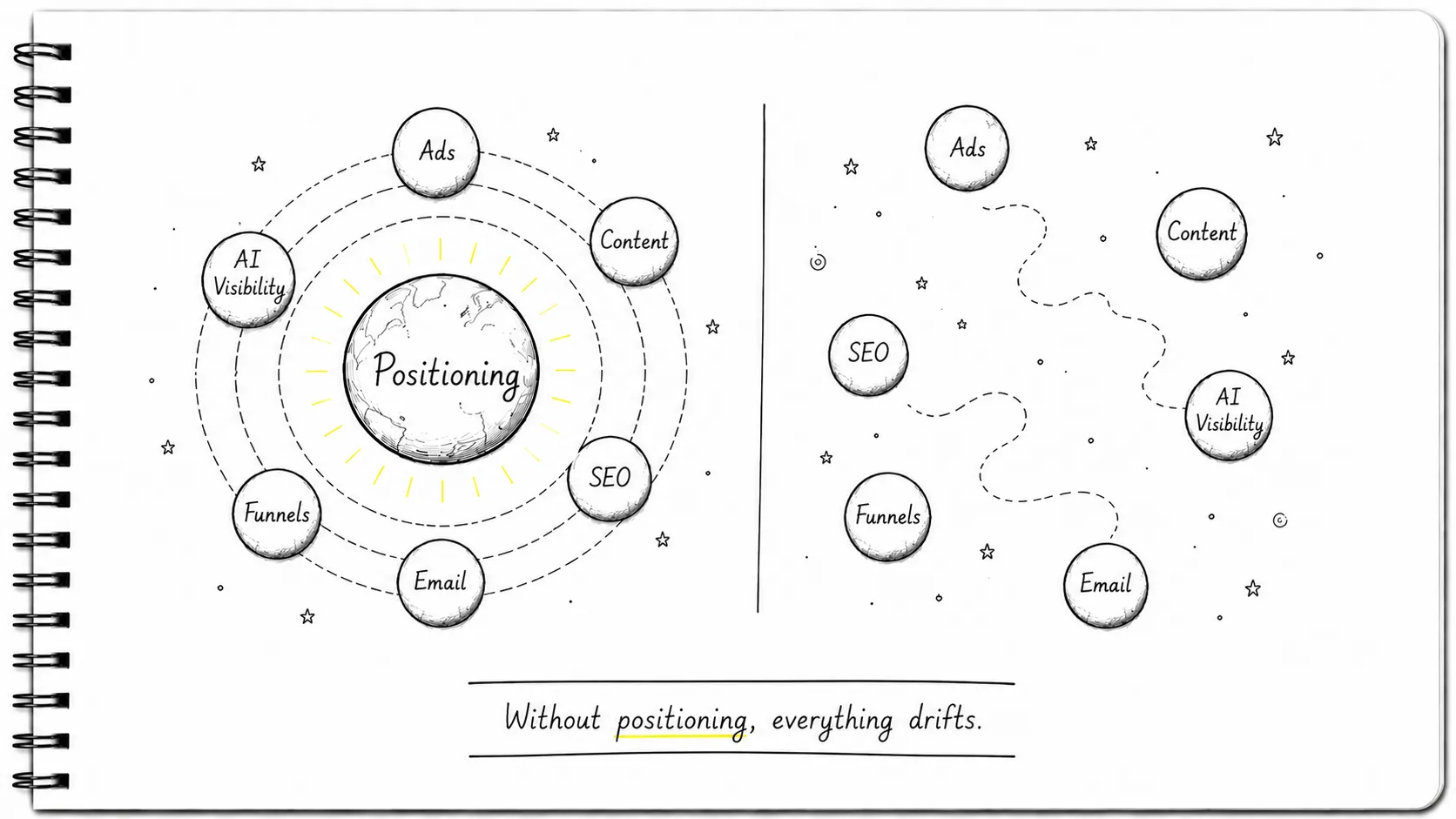
When positioning is unclear:
- Every campaign requires fresh thinking
- Every piece of content feels like starting over
- Every ad needs “testing” because there is no grounded hypothesis
So execution becomes cognitively expensive.
Not because execution is inherently hard, but because clarity hasn’t reduced the decision surface.
Partial clarity doesn’t stop action.
It creates fragmented action.
Clear Positioning Compresses Decisions
When positioning is clear, something subtle but powerful happens:
Execution becomes predictable.
Not in results but in direction.
You start seeing:
- Repeating message patterns
- Consistent audience resonance
- Faster campaign creation cycles
Because decisions are no longer made from scratch.
They are made from alignment.
Positioning is not a plan, but a filter through which decisions pass.
Execution Is Expression, Not Creation
A useful way to understand this:
Execution does not create clarity.
It expresses it.
When positioning is strong:
- Ads don’t feel like persuasion ➞ they feel like recognition
- Content doesn’t feel like effort ➞ it feels like articulation
- Funnels don’t “fix conversion” ➞ they reveal where alignment breaks
Execution surfaces truth.
If something feels off in execution, it is usually pointing back to positioning.
Why More Channels Make It Worse
A common reaction to underperforming execution is expansion:
- Add more platforms
- Try new formats
- Increase frequency
But without positioning clarity, this multiplies confusion.
Each new channel introduces:
- New decisions
- New interpretations of the same message
- New inconsistencies
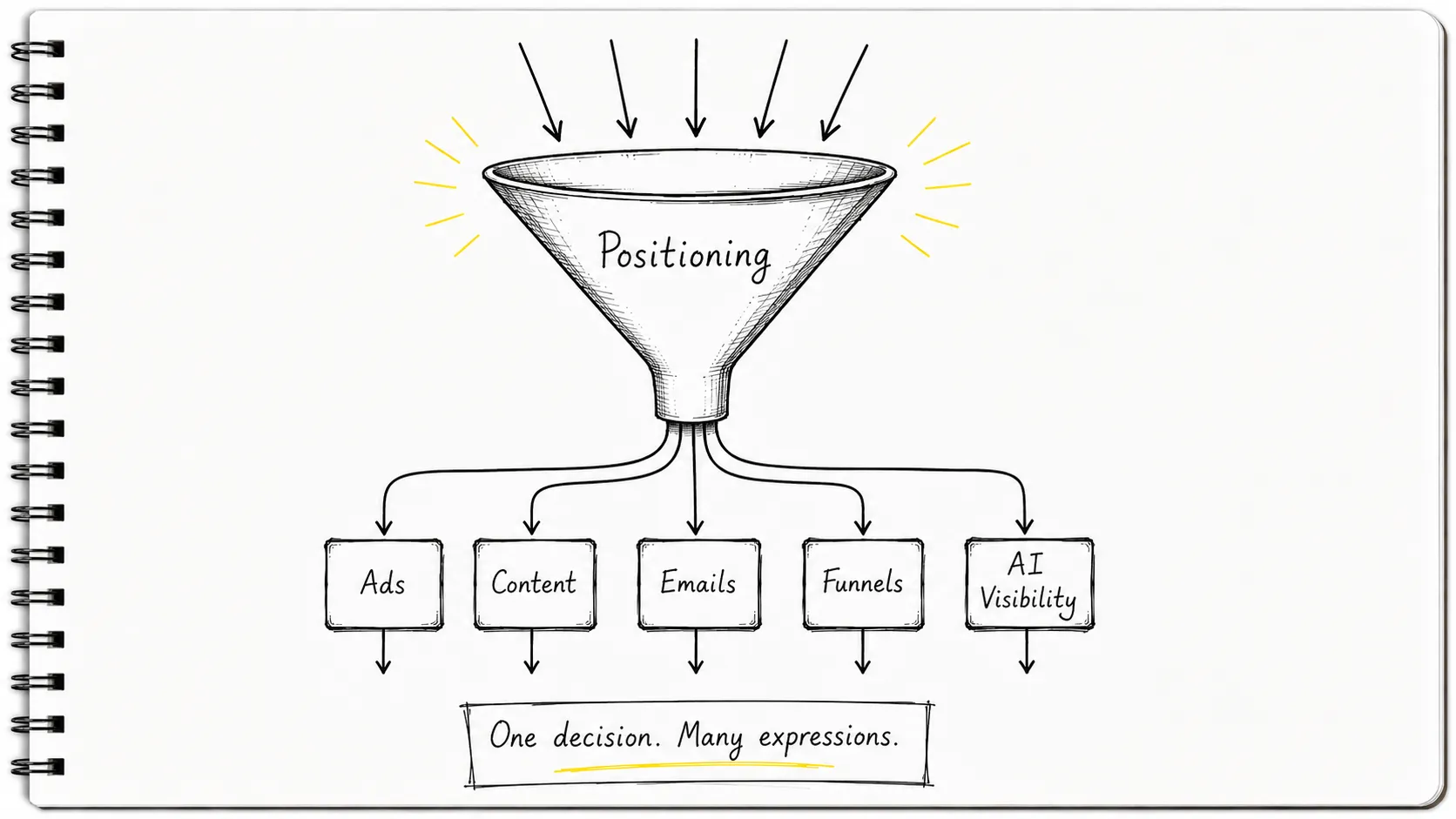
Instead of amplifying clarity, the system amplifies variation.
This is where founders feel like marketing is “active but not working.”
Because activity increased.
But alignment didn’t.
Positioning Creates Message Gravity
When positioning is right, your message starts behaving differently.
It begins to:
- Attract the right audience without force
- Repel the wrong audience without explanation
- Stay consistent across formats without dilution
This is not optimization.
It is coherence.
And coherence is what allows execution to scale without losing meaning.
Positioning strengthens that signal.
Execution Becomes Systemic, Not Situational
Without positioning:
- Execution is situational
- Dependent on mood, trends, and external input
With positioning:
- Execution becomes systemic
- Driven by internal clarity and repeatable patterns
This is where marketing starts compounding.
Not because more is being done.
But because what is being done is aligned.
Systems don’t begin with tools.
They begin with clarity that can be repeated.
The Real Shift
The shift is not:
“How do I execute better?”
It is:
“What is making execution unclear?”
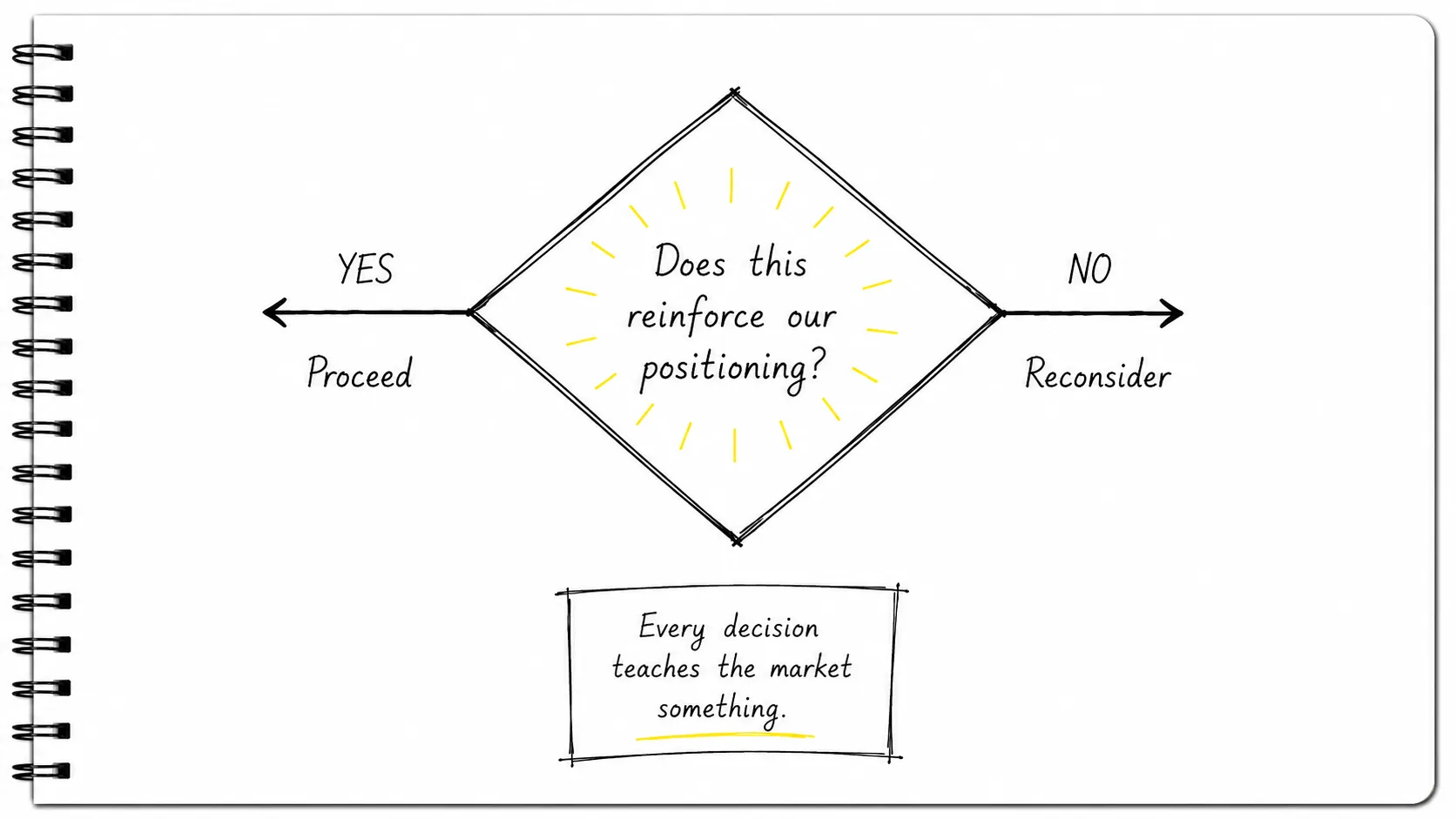
Because when positioning is right:
- Execution simplifies
- Decisions reduce
- Messaging stabilizes
- Results become interpretable
And most importantly, marketing starts to feel lighter.
Not easier in effort.
But clearer in direction.
Where Clarity Becomes Recognition
Where positioning starts (before words are written)
Where positioning gets diluted in execution
Where positioning becomes visible (or invisible) to systems
Where positioning aligns execution
What This Actually Means
Execution doesn’t fail randomly. It reflects where positioning is unclear.
If positioning is weak, decisions expand.
If positioning is clear, systems align.
That is why better execution rarely solves the problem.
Clearer positioning does.
