


Most marketing problems don’t begin where they appear.
They don’t begin in ad performance, funnel drop-offs, low conversion rates, or inconsistent leads.
Those are symptoms.
The origin is almost always earlier; quieter, less visible, and far more structural.
It begins in THINKING
The Invisible Layer Most Founders Skip
When marketing feels “active but not working,” the instinct is to adjust execution:
Change the ad creative > Test a new platform > Redesign the landing page > Rewrite the copy
But execution only amplifies what already exists.
If the underlying thinking is clear, execution compounds it.
If the thinking is fragmented, execution exposes it.
This is why two businesses can run the same funnel, the same ads, even the same offer, and get completely different outcomes.
Because what’s being amplified is not the tactic.
It’s the CLARITY behind it.
What “Thinking” Actually Means in Marketing
Thinking is not brainstorming ideas or consuming strategies.
It is the process of answering, with precision:
- Who is this really for?
- What is actually being solved?
- Why does it matter now?
- What transformation is being offered, not described, but felt?

Most marketing problems exist because these questions are answered partially, not fully.
And partial clarity doesn’t fail loudly.
It creates almost-working systems.
- Ads that get clicks but not conversions
- Content that gets engagement but not trust
- Funnels that generate leads but not decisions
This is the space where confusion hides.
Why Execution Feels Like the Problem
Execution is visible. Thinking is not.
So when something doesn’t work, execution becomes the default suspect.
But this creates a dangerous loop:
Misaligned thinking → Weak execution outcomes → More execution changes → Increased complexity →
Even less clarity
This is how marketing becomes heavy.
Not because marketing is complex, but because thinking is unresolved.
This idea is explored deeply in First Principles Marketing: Why Borrowed Strategies Stop Working
A Real Example: The Fitness Brand That Targeted Everyone
I worked with an Indian fitness brand that had a clear marketing problem… Ads weren’t converting, leads were inconsistent, and the team kept testing new creatives.
The instinct was to fix the ads.
But the actual problem was upstream.
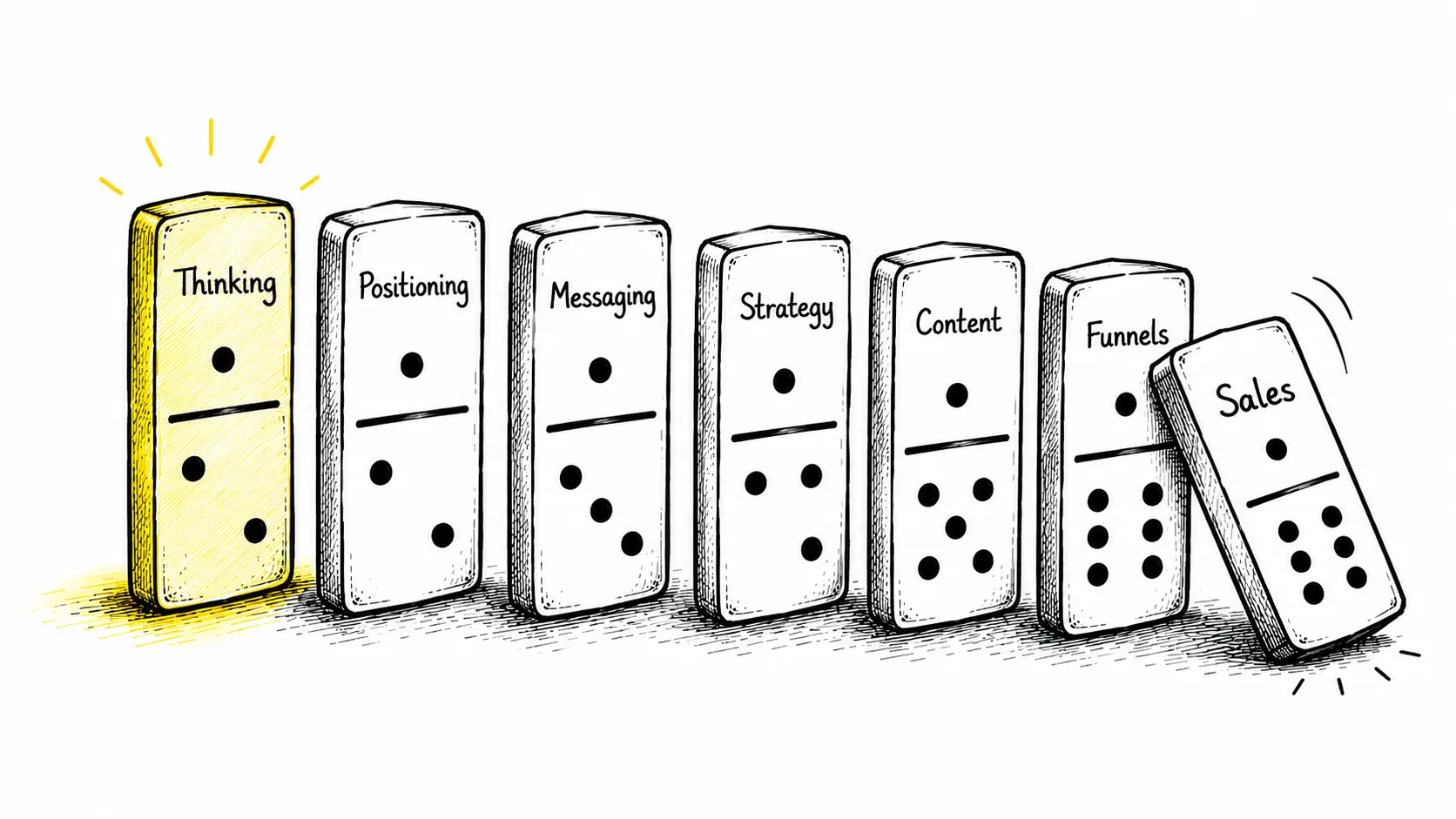
Their positioning was built around a single idea: everyone in India wants to lose weight.
And they weren’t wrong. The demand was real!
However, they were addressing that demand as if it were a single, homogeneous group: one problem, one message, one campaign.
It wasn’t !!
A man trying to lose weight before his wedding carries a different urgency than a woman trying to recover her body after pregnancy.
The goal is the same.
The context, the emotion, and the timeline are entirely different.
And marketing that speaks to the goal but misses the context lands flat.
An ad that claims “Lose weight in 14 days” competes with hundreds of others making the same promise.
An ad that says “Look your best before the big day” or “Get back to yourself after pregnancy” – that stops someone mid-scroll.
Because it reflects their specific moment, not a general desire.
The diagnosis came from their own data.
When I looked at their existing customer database, a pattern emerged:
“The majority of their actual buyers were working professionals.”
Not people preparing for their wedding, not new mothers, though those segments existed.
The segment that had already chosen them repeatedly was a working professional with limited time and high accountability.
That insight became the foundation for repositioning.
We stopped trying to speak to everyone and started speaking to that person, their schedule, their constraints, and their language.
Sales became easier.
Not because the ads got better. Because the THINKING got clearer!
Once that core segment was solid, expansion became natural.
The brand started layering in adjacent segments: working moms, post-pregnancy recovery, with the same discipline.
Specific context. Specific message. Specific resonance.
A note for founders just starting out
No database yet? Work with what you have.
Who’s engaging with your content? Who’s asking questions? Who’s leaning in, even without buying?
The signal is there… The database just makes it faster to find.
The Real Role of Channels
Channels don’t create growth.
They reveal it.
- A Facebook ad doesn’t fix positioning.
- A funnel doesn’t create demand.
- An email sequence doesn’t build trust from nothing.
They simply expose:
- How clearly you understand your audience
- How precisely you articulate value
- How aligned is your message with real desire
This is why the same channel feels “saturated” for some and “scalable” for others.
Because the constraint isn’t the platform.
It’s the thinking behind how it’s used.
The Emotional Layer Most Marketing Misses
People don’t make decisions based on information. They make decisions based on resonance.
And resonance is not created by better wording.
It is created by deeper understanding.
For example:
A retreat is not booked because of the itinerary details, it is booked because something internal feels seen
A service is not chosen because of features
It is chosen because the problem feels understood
When thinking is shallow, messaging becomes descriptive. When thinking is clear, messaging becomes reflective.
This is the difference between:
“Here’s what we offer” vs “This is what you have been trying to find.”
Where Misalignment Actually Starts
Misalignment doesn’t begin in campaigns. It begins in small, early decisions:
- Slightly broad target audience
- Slightly unclear positioning
- Slightly generic messaging
- Slightly borrowed strategy
Individually, these seem harmless.
But together, they compound.
This accumulation has a name: Tactic Culture. It’s the environment that keeps founders reaching for borrowed ideas instead of examining the thinking underneath.
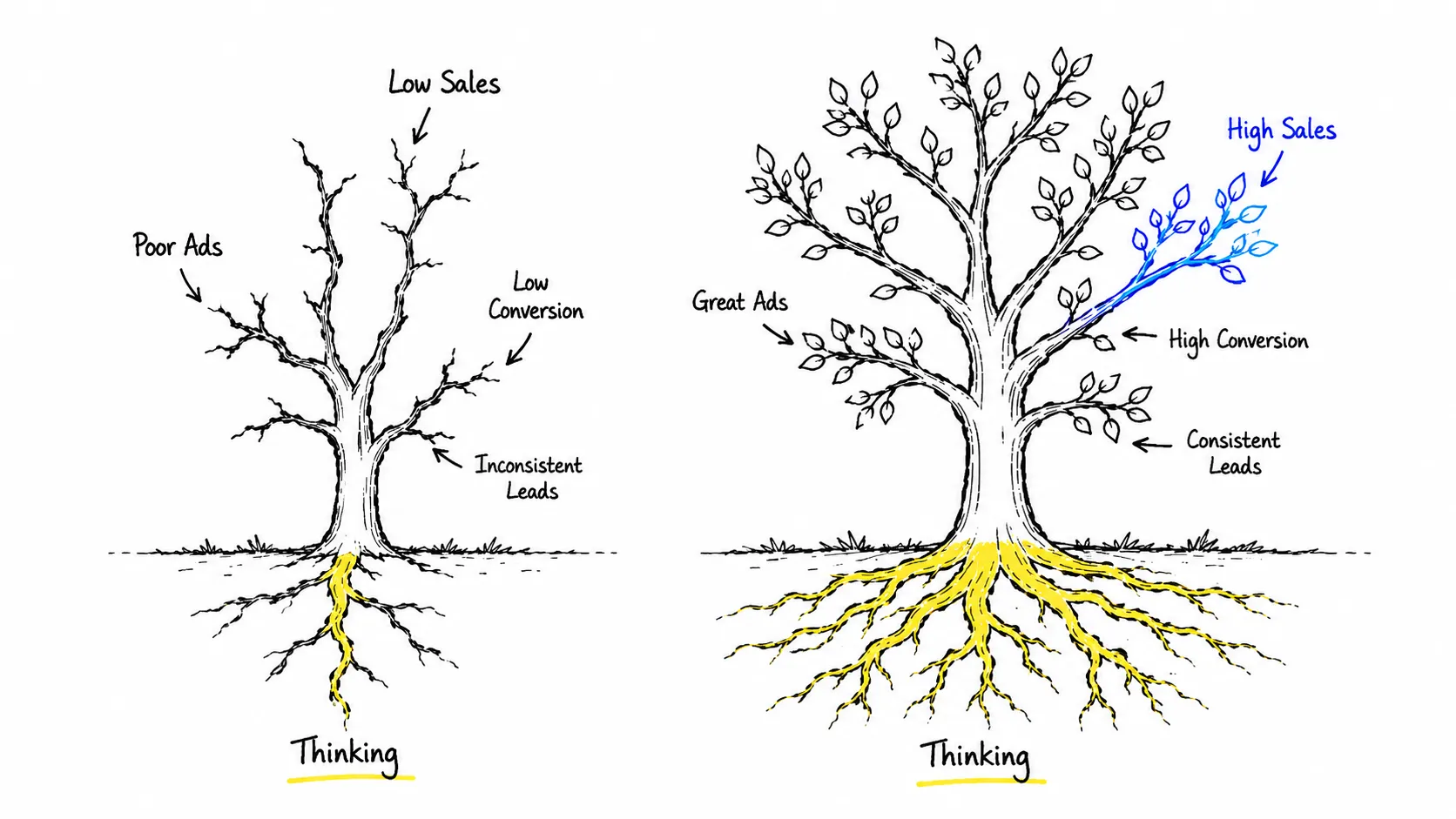
This is what creates what feels like “random inconsistency” in marketing.
But it’s not random.
It’s accumulated drift.
Explored further in;
Why More Effort Doesn’t Solve It
When results drop, effort usually increases.
More content
More campaigns
More tools
More experiments
But effort applied to unclear thinking doesn’t create growth.
It creates noise.
This is why many founders feel like they are “doing everything right” but still not seeing momentum.
Because the issue is not activity.
It’s coherence.
Alignment + Articulation
This is where the core principle becomes practical.
Alignment is internal clarity:
- Who you serve
- What you solve
- Why it matters
Articulation is external clarity:
- How clearly that truth is expressed
- How easily it is understood
- How naturally it resonates
When alignment is weak, articulation becomes forced.
When alignment is strong, articulation becomes simple.
Growth happens when both are present.
This is expanded in Alignment + Articulation = Growth
What Changes When Thinking Is Clear
When thinking is resolved: Marketing decisions become faster, Messaging becomes lighter
Channels become leverage, not experiments
Consistency emerges naturally

You stop asking:
“What should I try next?”
And start seeing:
“What is already clear enough to scale?”
Everything Else Starts From Here
What you have seen in this article is not one part of marketing.
It’s what SHAPES everything that follows.
When thinking is unclear:
- Execution becomes scattered
- Measurement becomes confusing
- Growth feels inconsistent
To see how this shows up across marketing:
How unclear thinking affects execution
- Why Funnels Don’t Fix Marketing, They Reveal It
- Why Most Marketing Dashboards Create More Confusion Than Clarity
How it impacts structure and alignment
How it affects outcomes
How it all comes together
A simple perspective
Marketing rarely fails because of tools or channels. It fails because the thinking behind them is unclear.
Everything else is a reflection of that.
What This Actually Means
Marketing problems don’t start where they appear. They start where thinking is unclear.
If thinking is fragmented, everything downstream reflects it.
If thinking is clear, systems align naturally.
That is why better tactics rarely solve anything.
Clearer thinking does.
